
Ceramic manufacturing regions in China can look similar from a distance, but they often behave very differently once sampling, glazing, decoration, packaging, and mass production begin. Buyers may assume “ceramic cup” is one simple category. That assumption can create delays, inconsistency, and hidden costs. I usually start by matching the project to the right supply chain, not just the right region.
The main differences between ceramic manufacturing regions in China come from material bases, local craft skills, factory organization, production habits, MOQ expectations, decoration capability, and quality control systems. No region is automatically best. The right choice depends on the buyer’s cup shape, glaze, artwork, order quantity, budget, delivery timeline, and inspection requirements.
I have worked on ceramic drinkware projects where the first sample looked promising, but mass production became difficult because the supplier’s real strength did not match the product. That is why I view regions as sourcing clues, not final answers.
What do the differences between ceramic manufacturing regions in China mean for buyers?
A buyer may start with a simple request: “I need a ceramic mug factory in China.” The problem is that this sentence hides many technical decisions. If those decisions are ignored, the buyer may receive beautiful samples, unstable production, or a final cost that no longer matches the quotation.
The differences between ceramic manufacturing regions in China matter because each region often develops around certain materials, worker skills, production models, and business habits. Buyers should use regional knowledge to narrow supplier options, then verify whether a specific factory can control sampling, decoration, quality, packaging, and delivery for the exact project.
Regional knowledge is useful, but it is not a shortcut
In my experience, overseas buyers often ask one of two questions:
- Which Chinese ceramic region is best?
- Which factory can make my design reliably?
The second question is much more useful.
Ceramic drinkware is not one product category. A straight white coffee mug, a reactive glaze cup, a hand-painted gift mug, a double-wall ceramic tumbler, and a ceramic cup with a silicone lid can all sit under the “ceramic cup” label. But they may require very different production routes.
A region may have many suppliers. Some may be strong in high-volume standardized production. Some may depend on subcontracted decoration workshops. Some may be flexible for small custom orders. Some may be better at hand finishing but slower in mass production. These differences affect real buyer decisions.
What usually creates regional differences?
I normally look at six practical factors before I talk about region names:
| Evaluation factor | Why it matters for buyers | What to verify |
|---|---|---|
| Clay and material base1 | It affects color, firing behavior, strength, and glaze performance | Material type, firing temperature, body color, food-contact compliance documents |
| Glaze capability | It affects appearance, consistency, and defect rate | Color stability, pinholes, crawling, crazing, lead/cadmium test reports where required2 |
| Decoration skills | It affects logo accuracy, artwork detail, and durability | Decal, underglaze, overglaze, hand-painting, silk screen, laser or other methods |
| Factory organization | It affects delivery control and responsibility | In-house processes versus outsourced steps |
| MOQ and pricing model | It affects project feasibility | MOQ by shape, color, glaze, packaging, and decoration |
| QC system | It affects buyer risk | AQL inspection3, production checkpoints, packing control, traceability |
The buyer’s hidden risk
The biggest risk is not choosing the “wrong region.” The bigger risk is assuming that one ceramic supplier can make every cup.
A supplier may show a good showroom. A salesperson may say, “Yes, we can do it.” But if the project does not fit the factory’s real production base, the order may be transferred to another workshop. This is not always bad. Many ceramic supply chains use collaboration.4 But it becomes risky when the buyer does not know:
- Who controls the body forming?
- Who controls the glaze?
- Who applies the decoration?
- Who performs final inspection?
- Who is responsible if mass production does not match the sample?
- Who manages packaging and export deadlines?
I once saw a project where the sample had a beautiful handmade texture. The buyer approved it quickly. During mass production, the texture varied too much from carton to carton. The issue was not only workmanship. The supplier had moved part of the production to a different workshop to meet the delivery date. The lesson was simple: sampling capability and mass production capability must be verified together.
For ceramic drinkware buyers, regional knowledge should support supplier selection. It should never replace product-specific evaluation.
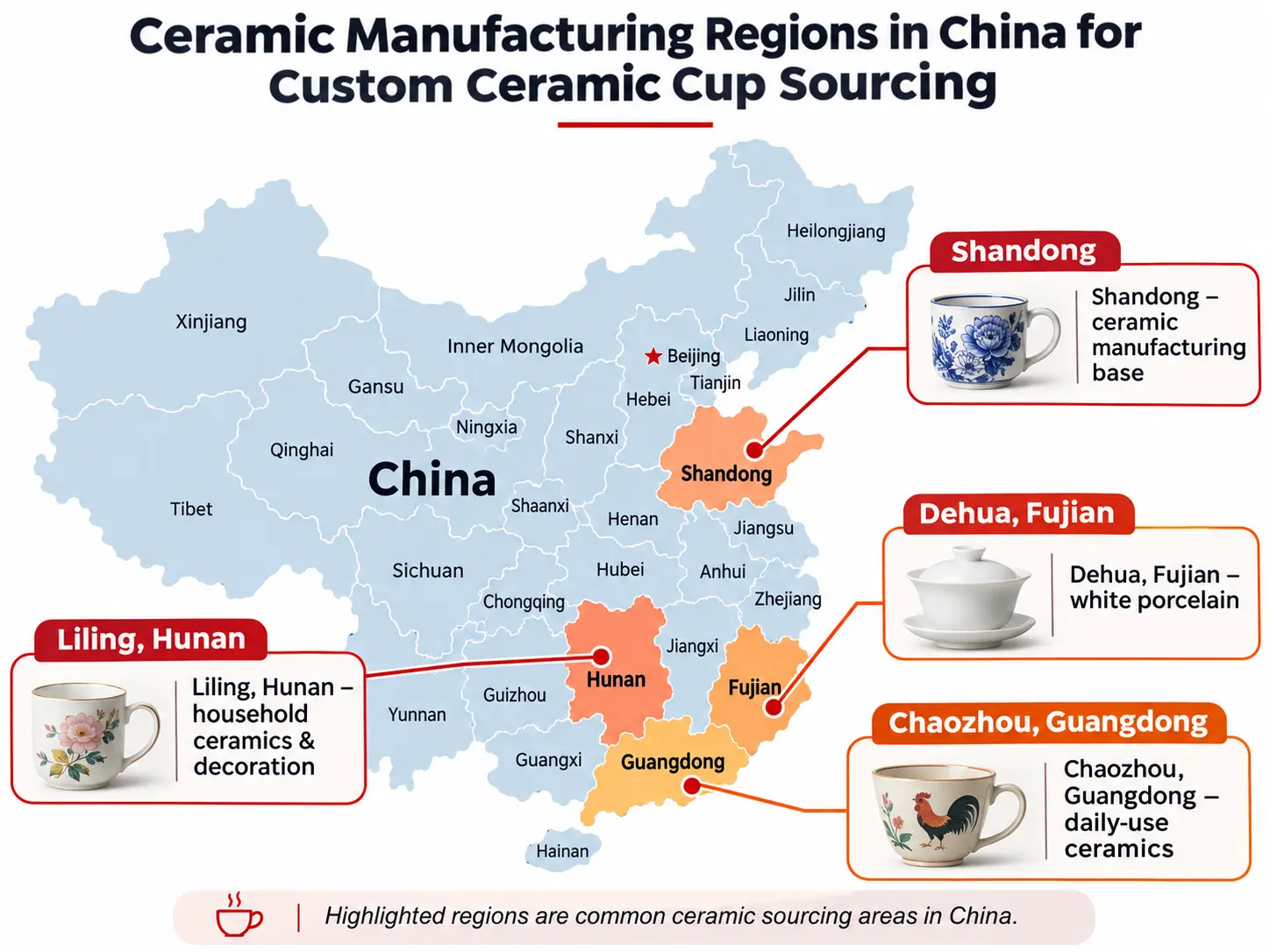
How do Chaozhou, Hunan, and Dehua differ in ceramic cup sourcing?
Many buyers hear names like Chaozhou, Hunan, and Dehua when they explore ceramic manufacturing regions in China. The problem starts when these names become fixed labels. A buyer may assume one region is “cheap,” another is “premium,” and another is “artistic.” That thinking is too simple and can mislead sourcing decisions.
Chaozhou, Hunan, and Dehua can show different sourcing tendencies, but buyers should treat them as examples, not rankings. Chaozhou is often linked with workshop-style collaboration, Hunan with more assembly-line production habits, and Dehua with hand-painting strengths. However, each factory still needs individual verification.
Chaozhou: flexible networks and subcontracting tendencies
Chaozhou is commonly known in many sourcing discussions for ceramics and related household products.5 In drinkware projects, I often see flexible supplier networks there. Some suppliers can coordinate multiple steps through nearby partners or workshops. This can be useful when a project needs several craft steps.
However, flexibility can come with management questions.
Buyers should ask:
- Is the forming done in-house?
- Is glazing done by the same factory?
- Are decals or special finishes outsourced?
- Who controls color matching?
- Can the supplier keep the approved sample standard during mass production?
- Can the supplier provide stable packaging and carton quality?
Workshop-style collaboration can be efficient when managed well. But it can create risk when process ownership is unclear. For example, if a ceramic mug needs a special glaze, a gold rim, and individual gift box packaging, several parties may touch the order. If one step is late or inconsistent, the whole shipment is affected.
Hunan: production-line habits and larger-order thinking
In many buyer discussions, Hunan is often associated with more organized production-line models for certain ceramic products.6 This does not mean every Hunan factory is large or automated. It means buyers may find suppliers that think in terms of batch production, line balance, and repeatable output.
This can help when the project has:
- A more standardized mug shape
- Clear decoration specifications
- Medium to large order volume
- Tight cost targets
- Repeat orders across seasons
- Retail packaging requirements
The trade-off may be flexibility. Some production-oriented factories prefer stable specifications. They may not want to change glaze, handle small mixed designs, or accept complex handwork unless the order quantity justifies it.
For a buyer, this means the question should not be, “Is Hunan better?” The better question is, “Does this factory’s production model fit my order size and customization level?”
Dehua: hand-painting and decorative craft tendencies
Dehua is often discussed for ceramic craft and decorative strengths.7 In some ceramic drinkware projects, buyers may explore Dehua when they need a more artistic surface, hand-painted effect, or gift-oriented ceramic item. Again, this is a tendency, not a rule.
Hand-painting and craft decoration can create value, but they also create control challenges:
| Project requirement | Buyer benefit | Possible risk |
|---|---|---|
| Hand-painted pattern | Unique appearance | Variation between pieces |
| Complex color layers | Premium shelf appeal | Longer sampling time |
| Gift-style ceramic cup | Higher perceived value | Higher packaging and breakage control needs |
| Small-batch craft order | Flexible market testing | Higher unit cost |
A hand-painted ceramic mug should not be judged like a fully machine-standardized item. Buyers need to define acceptable variation. They should set clear reference samples, color ranges, inspection criteria, and packaging standards.
How I compare regions in real projects
When I compare ceramic manufacturing regions in China, I do not start with a ranking table. I start with the product.
For example:
- A simple promotional mug may need cost control, consistent logo printing, and fast delivery.
- A retail gift mug may need better packaging, surface finish, and lower visual defect rates.
- A hand-painted ceramic cup may need craft skill and a clear tolerance standard.
- A reactive glaze cup may need buyer education because every piece may look slightly different.
- A ceramic travel cup with lid may need accessory matching, silicone testing, and packaging drop-test attention.
Each project points to a different type of supplier. The region can guide the search, but the factory’s real capability decides the result.
Why can one ceramic factory fail across different cup projects?
A buyer may feel safe after finding one ceramic supplier. The supplier may have good communication, fair pricing, and previous export experience. The problem appears when the next design is very different from the first one. A factory that performs well on one mug may struggle with another.
One ceramic factory can fail across different cup projects because ceramic drinkware depends on shape, body material, firing process, glaze behavior, decoration method, manual skill, packaging, and production control. A supplier may be strong in one combination but weak in another, especially if it outsources unfamiliar processes.
“Ceramic cup” is not one manufacturing process
I always remind buyers that a ceramic cup is a system of decisions. Each decision changes the supply chain.
Important product variables include:
-
Body shape
- Straight mug
- Belly mug
- Tall cup
- Espresso cup
- Bowl-shaped cup
- Double-wall structure
-
Material and firing
- Stoneware
- Porcelain
- Bone china-style body
- High-temperature ceramic
- Lower-temperature decorative ceramic
-
Surface treatment
- Glossy glaze
- Matte glaze
- Reactive glaze
- Speckled glaze
- Color glaze
- Unglazed texture
-
Decoration
- Decal
- Screen printing
- Hand-painting
- Embossed logo
- Debossed logo
- Gold or metallic effect
-
Use and compliance
- Food-contact use
- Dishwasher requirement
- Microwave requirement
- Retail market requirements
- California Prop 65 concern for some buyers8
- EU food-contact expectations for European buyers9
A factory may handle one combination well but not another. For example, a supplier that makes white decal mugs efficiently may not be the best choice for a reactive glaze cup with strict color matching. Reactive glazes are naturally variable.10 If the buyer wants every piece to look identical, the project needs careful expectation setting.
Sampling success does not always prove mass production control
A good sample is important, but it is not enough.
A sample may be made by:
- A senior worker
- A small workshop
- A different kiln
- A more careful decoration team
- A slower hand-finishing process
- A special material batch
Mass production may use another line or another subcontractor. This difference can create problems in:
- Color consistency
- Mug weight
- Rim smoothness
- Handle strength
- Logo position
- Glaze defects
- Pinholes
- Warpage
- Packaging breakage
- Carton labeling
In our own OEM/ODM work, I have learned to ask for process clarity before order confirmation. I want to know how the approved sample will be converted into production standards. A supplier should be able to explain the control points, not only show a nice mug.
A practical project-fit checklist
Before a buyer approves a ceramic supplier, I suggest checking the supplier against the project, not against a general factory profile.
| Buyer question | Why it matters |
|---|---|
| Has the factory made this shape before? | New shapes may require mold changes and higher defect rates |
| Has it made this glaze before? | Glaze stability can affect color and food-contact testing |
| Is decoration in-house or outsourced? | Outsourcing can affect schedule and accountability |
| Can the supplier define acceptable color variation? | Ceramic colors can shift after firing |
| What is the normal defect rate? | Buyers need realistic cost and delivery planning |
| Can the supplier pack for export shipping? | Ceramic breakage risk is real |
| Can the supplier support third-party inspection? | Serious buyers need objective shipment checks |
Hidden cost is often more important than unit price
A low unit price can become expensive if the project does not fit the factory.
Hidden costs may include:
- Extra sampling rounds
- Mold adjustment fees
- Higher breakage rate
- Repacking labor
- Delayed shipment
- Air freight for late delivery
- Retail chargebacks
- Customer complaints
- Re-inspection costs
- Discounting defective inventory
This is why supplier selection should include both price evaluation and risk evaluation. A slightly higher unit price from a better-matched supplier may save money in the full project.
My usual advice is simple: do not ask whether a ceramic factory is “good.” Ask whether it is good for this exact cup, this exact artwork, this exact MOQ, and this exact market.
How should buyers evaluate ceramic manufacturing regions in China before placing orders?
Buyers often feel pressure to move fast. They may compare quotations first and factory details later. That creates trouble because ceramic manufacturing regions in China can have different MOQ habits, process structures, and quality risks. If the buyer does not ask the right questions early, problems appear after deposit payment.
Buyers should evaluate ceramic manufacturing regions in China by first defining the product, then matching it with supplier capability, sample control, production process, quality system, compliance documents, packaging strength, and delivery plan. Region should guide supplier discovery, but final approval should depend on verified factory performance.
Step 1: Define the cup before searching for a region
A clear product brief saves time. I prefer to receive a specification sheet before I recommend a ceramic supply route.
A useful ceramic cup brief should include:
- Cup capacity, such as 300 ml, 350 ml, or 12 oz
- Shape reference or 3D drawing
- Material preference, such as stoneware or porcelain
- Glaze type and color standard
- Logo size and decoration method
- Dishwasher or microwave expectations
- Order quantity and repeat-order plan
- Target market, such as EU, U.S., Japan, or Korea
- Packaging style, such as bulk pack, white box, color box, or gift box
- Inspection standard, such as AQL level
- Delivery deadline
- Target price range
Without this information, supplier comparison becomes weak. One factory may quote based on a simple glaze. Another may include better packaging. Another may assume outsourced decoration. The buyer may think the quotes are comparable, but they are not.
Step 2: Ask what the supplier really controls
I do not expect every supplier to do everything in-house. Ceramic supply chains often involve specialized partners. The key is transparency.
Buyers should ask:
- Which processes are in-house?
- Which processes are outsourced?
- Who owns the mold?
- Who controls glaze formulation or glaze sourcing?
- Who applies the decoration?
- Who performs final QC?
- Can the supplier provide production photos or process records?
- Can a third-party inspection company visit before shipment?
If a supplier avoids these questions, buyers should slow down. A good manufacturing partner does not need to reveal trade secrets, but it should explain responsibility clearly.
Step 3: Compare supplier types, not only regions
Here is a practical way to think about supplier options:
| Supplier type | Possible strength | Possible limitation | Best-fit buyer need |
|---|---|---|---|
| Source factory with focused process | Stable control in its specialty | May reject complex mixed projects | Repeatable designs and stable orders |
| Factory with partner workshops | Flexible craft combinations | Needs strong project management | Customized cups with multiple processes |
| Trading company | Broad supplier access | Less direct process control unless experienced | Buyers needing sourcing support |
| OEM/ODM drinkware manufacturer | Project coordination across materials and categories | Must verify actual ceramic partner capability | Brands needing one-stop development and export handling |
| Craft-focused workshop | Special surface or handwork | Lower output and higher variation | Gift or artistic ceramic products |
As a drinkware OEM/ODM manufacturer, I see value in coordination. But I also believe buyers should verify who does what. A one-stop supplier should still provide clear project control, sample tracking, quality standards, and export packaging management.
Step 4: Treat certifications and test reports as documents to verify
Many suppliers will mention certifications, audits, or food-contact test reports. Buyers should review these carefully.
Important points include:
- The document should match the factory name or relevant supplier entity.
- The test report should match the material and decoration used in the order.
- The report should be recent enough for the buyer’s internal policy.
- The market requirement should match the destination country.
- Metallic or colored decorations may need special attention.
- Buyers should use qualified testing laboratories when needed.
I do not recommend relying on verbal claims. For application-specific compliance, buyers should consult qualified testing professionals, import advisors, or compliance specialists.
Step 5: Build a sample-to-production control plan
A serious ceramic project needs more than one approved sample photo.
A basic control plan may include:
- Signed golden sample
- Color range sample for acceptable variation
- Weight tolerance
- Capacity tolerance
- Logo position tolerance
- Rim and handle inspection criteria
- Glaze defect limit
- Packaging drop-test requirement if needed
- Pre-production sample approval
- During-production inspection for large orders
- Final random inspection before shipment
This control plan helps both sides. The buyer gets clearer expectations. The supplier gets a practical standard to follow. It also reduces arguments after production.
Step 6: Check packaging early
Ceramic drinkware is fragile.11 Good production can still fail if packaging is weak.
Buyers should review:
- Inner box material
- Carton strength
- Divider design
- E-commerce packaging requirements
- Pallet loading method
- Drop-test needs
- Barcode and label accuracy
- Retail shelf presentation
- Moisture control for long sea shipping
For ceramic mugs sold in retail channels, packaging is part of the product. For online channels, packaging is part of damage control. The right factory or supply chain must understand both.
Frequently Asked Questions
Which ceramic manufacturing region in China is best for mugs?
No single region is best for all mugs. The right region depends on mug shape, glaze, decoration, MOQ, price target, packaging, and quality standard. Buyers should use regional knowledge to shortlist suppliers, then verify each factory’s actual experience with the specific ceramic cup project.
Is Chaozhou, Hunan, or Dehua better for custom ceramic cups?
Each region may show different tendencies, but none should be treated as universally better. Chaozhou may offer flexible supplier networks, Hunan may suit more production-line projects, and Dehua may fit decorative or hand-painted work. Buyers should confirm factory capability, sampling control, and mass production consistency.
Why do ceramic mug samples look different from mass production?
Samples may be made with extra care, different workers, smaller kilns, or special material batches. Mass production introduces batch variation, glaze changes, decoration alignment issues, and packaging pressure. Buyers should set golden samples, tolerance ranges, and inspection standards before approving bulk production.
Should I choose a ceramic supplier by region or by factory capability?
Buyers should choose by factory capability first. Region can help identify possible supplier clusters, but final selection should depend on product fit, process control, quality management, compliance documents, communication, delivery reliability, and willingness to support inspection.
What documents should buyers verify for ceramic drinkware orders?
Buyers should verify food-contact test reports, relevant factory audits if required, material declarations, and packaging specifications. The documents should match the product, decoration, factory entity, and target market. For strict applications, buyers should consult qualified compliance or testing professionals.
Conclusion
The differences between ceramic manufacturing regions in China are real, but they should not be used as a simple ranking. A better sourcing decision starts with the cup itself: shape, glaze, decoration, MOQ, packaging, compliance needs, and quality expectations. Region can guide the search, but verified factory capability decides the result. If you are developing custom ceramic drinkware, I can help you review your project requirements and match them with a practical OEM/ODM production route.
"Notes on Clay & Glaze:", https://www.valdosta.edu/colleges/arts/art/documents/ceramics-documents/NotesonClay-Glazev1.pdf. Ceramic engineering sources describe clay body composition and firing conditions as determinants of fired color, mechanical strength, shrinkage, and glaze fit in ceramic products. Evidence role: mechanism; source type: education. Supports: Clay body composition and firing conditions influence fired color, mechanical properties, and glaze compatibility.. ↩
"Guidance on Imported Traditional Pottery Intended for Use ...", https://www.fda.gov/regulatory-information/search-fda-guidance-documents/guidance-industry-safety-imported-traditional-pottery-intended-use-food-and-use-term-lead-free. Government food-contact guidance identifies lead and cadmium release from ceramicware as regulated safety concerns, supporting the need for product-specific test reports where the destination market requires them. Evidence role: general_support; source type: government. Supports: Lead and cadmium migration from ceramic food-contact articles is regulated or monitored in major markets, and testing may be required for compliant trade.. ↩
"What kinds of Lot Acceptance Sampling Plans (LASPs) are ...", https://www.itl.nist.gov/div898/handbook/pmc/section2/pmc22.htm. Standards and quality-control references define AQL as an acceptance quality limit used in sampling inspection, providing a formal basis for its use in shipment or production-lot checks. Evidence role: definition; source type: institution. Supports: AQL refers to an acceptance quality limit used in sampling inspection to evaluate production lots.. Scope note: AQL defines a sampling approach and acceptance threshold; it does not guarantee that every unit in a lot is defect-free. ↩
"The ceramic industrial district facing the challenge from ...", https://www.academia.edu/883587/The_ceramic_industrial_district_facing_the_challenge_from_China. Research on Chinese industrial clusters describes production networks in which specialized firms and workshops divide manufacturing tasks, providing contextual support for collaborative ceramic supply chains. Evidence role: general_support; source type: paper. Supports: Ceramic manufacturing clusters can involve specialized firms or workshops that divide production stages across a local network.. Scope note: Such research may describe industrial clusters generally and may not prove the operating model of any individual supplier. ↩
"Ceramic", https://en.wikipedia.org/wiki/Ceramic. Official or institutional descriptions of Chaozhou's industrial profile identify ceramics as an established local sector, giving historical and economic context for its mention in ceramic sourcing discussions. Evidence role: historical_context; source type: government. Supports: Chaozhou has an established ceramics industry connected with household or daily-use ceramic products.. Scope note: This supports Chaozhou's ceramic-industry relevance, not the capability or reliability of any specific Chaozhou supplier. ↩
"Liling Ceramics", https://www.lilingceramics.com/. Institutional accounts of Hunan's ceramic industry, including Liling, describe organized daily-use ceramic production, which provides contextual support for associating the region with production-line-oriented ceramic manufacturing. Evidence role: general_support; source type: institution. Supports: Parts of Hunan, such as Liling, have developed industrial-scale ceramic production for daily-use ceramics.. Scope note: The evidence would be regional and contextual; it should not be read as proof that every Hunan supplier uses the same production model. ↩
"Dehua porcelain", https://en.wikipedia.org/wiki/Dehua_porcelain. Reference sources on Dehua porcelain document the area's long-standing association with ceramic craft and porcelain production, supporting its use as a contextual example of a decorative ceramics region. Evidence role: historical_context; source type: encyclopedia. Supports: Dehua has a documented historical association with porcelain production and ceramic craft traditions.. Scope note: Historical reputation does not directly establish current mass-production capability for a specific drinkware order. ↩
"Proposition 65 - OEHHA - CA.gov", https://oehha.ca.gov/proposition-65. California government materials on Proposition 65 identify lead and cadmium as listed chemicals, supporting the article's statement that buyers of decorated ceramic drinkware may need to consider Prop 65 exposure-warning issues. Evidence role: general_support; source type: government. Supports: California Proposition 65 covers listed chemicals such as lead and cadmium, which can be relevant to ceramic food-contact products and decorations.. Scope note: Prop 65 applicability depends on the product, exposure level, and distribution into California. ↩
"Exposure to lead and cadmium released from ceramics ...", https://pubmed.ncbi.nlm.nih.gov/25526575/. European Union food-contact legislation for ceramic articles sets requirements for articles intended to contact food, including migration limits for lead and cadmium, supporting the need to verify EU food-contact compliance for ceramic drinkware. Evidence role: general_support; source type: government. Supports: The EU regulates ceramic articles intended to contact food, including limits for lead and cadmium release.. ↩
"Ceramics Manual V4 - Colorado 4-H - Colorado State University", https://co4h.colostate.edu/wp-content/uploads/sites/27/2026/03/Ceramics-Unit-5-Glazes.pdf. Ceramics education sources explain that reactive glaze effects arise from chemical and firing interactions, which can create natural variation in color, flow, and surface pattern between pieces. Evidence role: mechanism; source type: education. Supports: Reactive glaze effects depend on glaze chemistry, kiln atmosphere, firing temperature, and surface interaction, making consistent replication difficult.. ↩
"Journal of Applied Packaging Research", https://wmlapps.rit.edu/electronic/journals/JAPR/JAPR_0307.pdf. Packaging research and distribution-test standards treat brittle goods as vulnerable to impact and vibration damage, supporting the article's claim that ceramic drinkware requires suitable protective packaging. Evidence role: general_support; source type: research. Supports: Brittle products such as ceramic drinkware are susceptible to impact damage during distribution, making protective packaging and drop testing relevant.. Scope note: Packaging studies establish the general risk mechanism; actual breakage rates depend on product geometry, packaging design, and shipping conditions. ↩