
Stackable cups are becoming more attractive because many drinkware buyers face the same problem: freight costs keep rising, shelf space is limited, and consumers expect practical products. If a cup set takes too much space, landed cost grows quickly. A well-designed stackable cup helps with compact packing, better presentation, and wider daily use.
Stackable cups are a smart product choice because they reduce shipping volume, improve retail packaging value, fit many household scenarios, and work well for e-commerce and shelf display. For brand owners, importers, and trading companies, they can support lower logistics costs, higher perceived value, and easier product positioning.
I have seen many drinkware projects succeed not only because the cup looked attractive, but because the full product system made sense. The cup, packaging, carton loading, shelf layout, and consumer use all mattered. Stackable design connects these points in a simple way.
How Do Stackable Cups Reduce Shipping Costs?
Shipping cost is one of the first problems buyers notice when comparing drinkware designs. A beautiful cup may lose its advantage if it wastes carton space. Stackable cups reduce dead space and allow more units to fit into each carton.
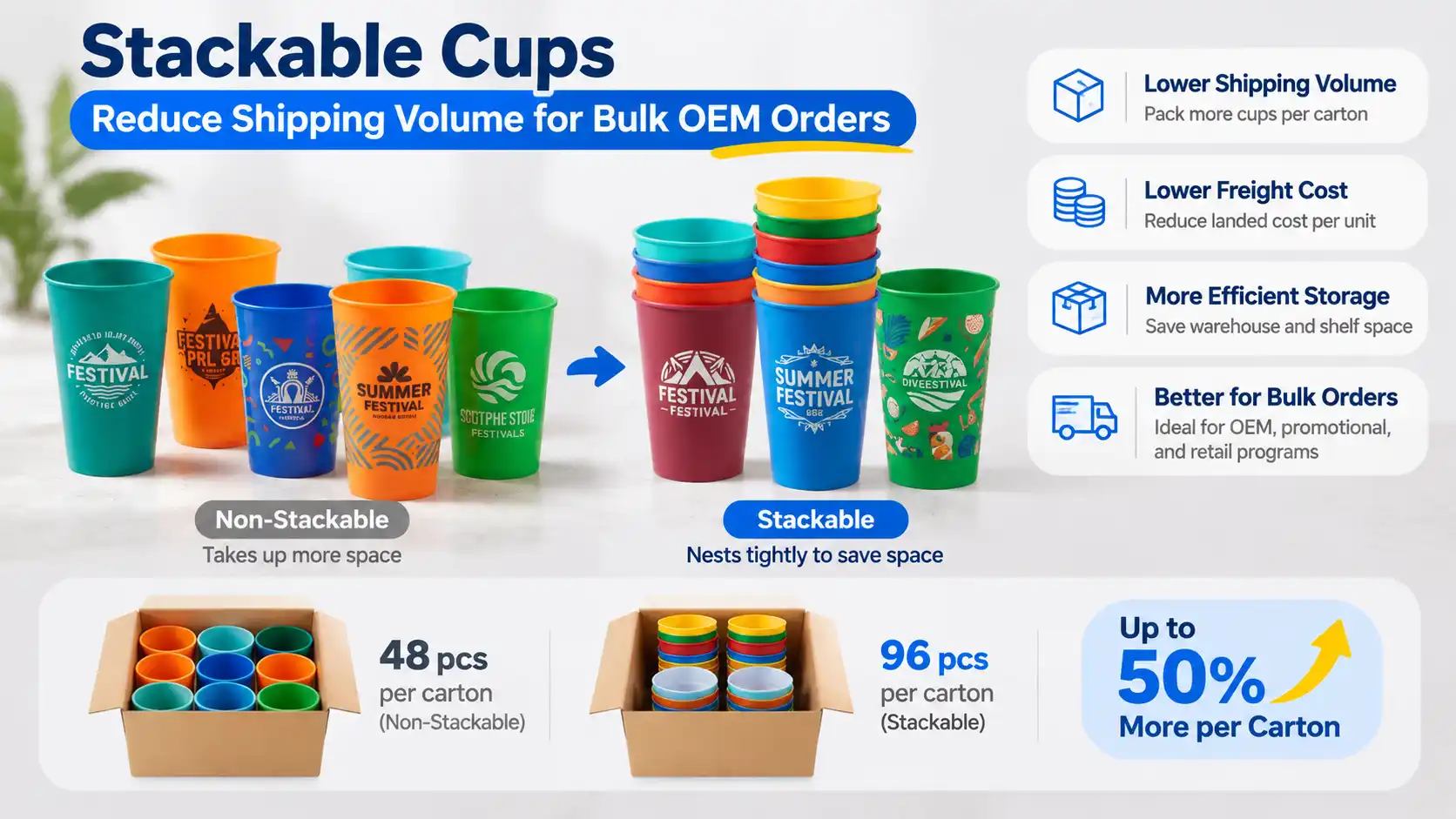
Stackable cups reduce shipping costs by lowering packed volume per piece. When cups nest securely, suppliers can load more units into inner boxes, master cartons, pallets, and containers. This improves container utilization and may reduce landed cost per unit, especially for bulky promotional and retail drinkware programs.
Why Volume Matters More Than Many Buyers Expect
For international drinkware procurement, freight is often calculated by actual weight or volumetric weight1, depending on the shipping method. Cups are usually not extremely heavy, but they can occupy a lot of space. This is why a small difference in nesting depth can affect final cost.
Buyers often focus first on unit price. That is reasonable, but it is not enough. A cup that is a few cents cheaper may become more expensive after shipping if it packs poorly.
| Item | Non-stackable Cup | Stackable Cup |
|---|---|---|
| Cup capacity | 16 oz | 16 oz |
| Pieces per inner box | 6 pcs | 12 pcs |
| Pieces per master carton | 48 pcs | 96 pcs |
| Estimated carton volume | Higher | Lower |
| Container utilization | Lower | Higher |
| Landed cost pressure | Higher | Lower |
The exact numbers depend on cup shape, rim diameter, height, handle design, and packaging method. Still, the direction is clear. Better nesting usually means better freight efficiency.2
Key Design Points Buyers Should Check
Not every cup that looks stackable is truly efficient. Buyers should review samples and packaging tests before confirming mass production. I usually suggest checking these points:
-
Nesting depth
The deeper the cup can nest without sticking, the more space it can save. -
Anti-jamming structure
A small step, rib, or shape adjustment can prevent cups from locking too tightly. -
Rim strength
The rim must stay stable when cups are stacked during packing and transport. -
Surface protection
Printed, coated, or color-changing surfaces should not scratch easily during nesting. -
Carton drop performance
Compact packing is useful only if the product survives transportation.
A smart stackable design should save space without creating quality problems during handling.
How This Helps B2B Buyers
For trading companies and overseas brands, lower packed volume can create several commercial advantages:
- More competitive quotation after freight is included
- Lower storage cost in overseas warehouses
- Better pallet efficiency for distributors
- Fewer cartons for e-commerce fulfillment
- More stable reorder planning because logistics cost is easier to control
When I evaluate a stackable cup project, I look at the cup plus the color box, inner packing, master carton, and loading plan. This helps buyers compare suppliers more fairly.
For large OEM or ODM orders, buyers should ask suppliers for packing details early:
- Product drawing with dimensions
- Single product weight
- Inner box dimensions
- Master carton dimensions
- Pieces per carton
- Gross weight and net weight
- Container loading estimate
- Drop test plan if required
These details allow the buyer to calculate a realistic landed cost and avoid surprises after the mold, artwork, or purchase order is confirmed.
Why Do Stackable Cups Increase Packaging Value?
Many drinkware products compete in crowded retail categories. If the product looks ordinary in the box, consumers may compare only price. Stackable cups create a better opportunity because a nested set can look neat, complete, and giftable inside a compact color box.
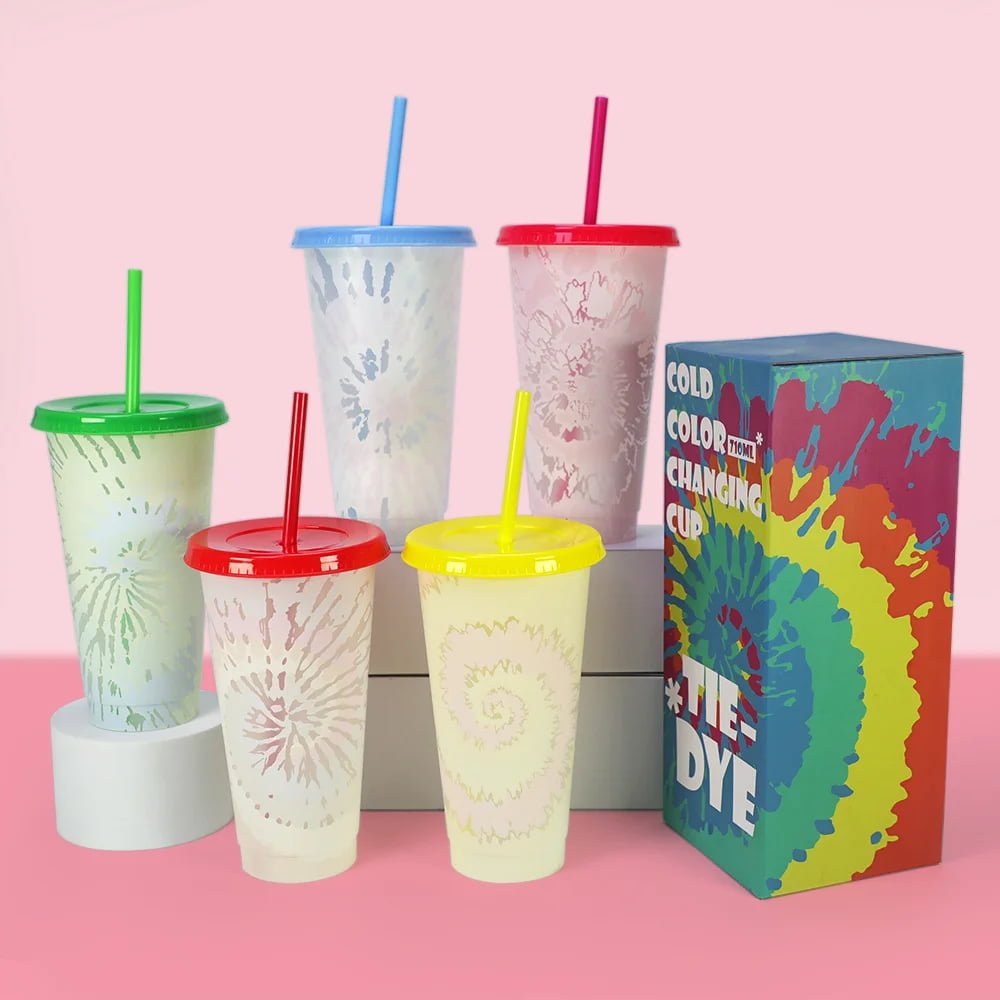
Stackable cups increase packaging value because they can be presented as a coordinated set in a smaller, cleaner package. A nested cup set can support better color matching, stronger retail storytelling, and higher perceived value than loose single cups, especially for seasonal, promotional, and family-use collections.
Why Packaging Changes the Perceived Price
Packaging does more than protect a product. It tells the buyer what the product is worth.3 A single cup may feel like a low-ticket item. A neatly nested set of two, four, or six cups can feel like a complete solution for home, travel, parties, or gifting.
This matters because the average order value4 can improve when the product is sold as a set. Instead of selling one cup at a time, the brand can sell a family pack, gift pack, picnic pack, or party pack.
| Packaging Format | Buyer Perception | Typical Use |
|---|---|---|
| Loose single cup | Basic, low price | Promotional giveaway |
| Single cup in box | Standard retail item | Gift or souvenir |
| Nested 4-piece set | Practical family product | Home, outdoor, party |
| Nested 6-piece set | Higher value bundle | Club stores, e-commerce |
| Mixed color nested set | More attractive | Seasonal campaigns |
How Color and Nesting Work Together
As a color-changing drinkware manufacturer, I pay special attention to how cups look as a set. A stackable structure gives more room for visual planning, such as:
- A gradient color story
- A warm-to-cold color-changing theme
- Different family member colors
- Holiday colors, such as red and green
- Brand colors for promotional campaigns
- Transparent, frosted, or solid color combinations
A buyer may choose a set of four cups where each cup changes color at a different temperature effect. The color box can show the before-and-after transformation, creating a stronger shelf message than a plain single cup.
Packaging Options Buyers Can Consider
Stackable cups can fit several packaging styles. The right choice depends on price point, sales channel, and product positioning.
-
Color box
- Good for retail and gifting
- Offers strong branding space
- Protects the set well
-
Window box
- Lets consumers see the colors directly
- Works well for color-changing drinkware
- May require extra structure for strength
-
Paper sleeve
- Cost-effective
- Suitable for warehouse clubs or simple retail
- Uses less packaging material
-
E-commerce mailer box
- Designed for direct shipping
- Can reduce damage risk
- Useful for online brands
-
PDQ display tray
- Suitable for shelf-ready retail
- Helps store staff restock quickly
- Supports impulse purchase
Quality Points Inside the Color Box
Nested packaging should be tested carefully. If the cups rub during transport, the surface may show scratches. This is especially important for printed logos, metallic coatings, or color-changing finishes.
Buyers should confirm:
- Whether a paper divider is needed
- Whether each cup needs a polybag or tissue wrap
- Whether the coating can handle contact during vibration
- Whether the box structure prevents movement
- Whether the barcode, warning text, and material symbols are correct
Certifications and compliance documents should also be verified. Depending on the market and material, buyers may request documents related to food contact requirements, such as FDA-related testing for the U.S. market or LFGB-related testing for certain European buyers. These documents should be reviewed with qualified testing labs and compliance professionals.
How Do Stackable Cups Fit Different Family Scenarios?
Consumers want products that work in real life, not only in product photos. A cup set may be used at breakfast, in the garden, near the pool, during a picnic, or in a child’s room. Stackable cups fit these scenes because they save space and are easy to store.
Stackable cups fit family scenarios because they are compact, easy to organize, and practical for repeated daily use. Families can store them in kitchen cabinets, take them outdoors, use them for parties, or assign different colors to different people. This makes the product simple, useful, and easy to understand.
Why Household Storage Drives Product Choice
Many consumers have limited kitchen space5. Cabinets are full of mugs, bottles, bowls, lunch boxes, and small appliances. A cup that stacks neatly solves a common household problem.
This practical benefit is easy for brands to communicate:
- “Save cabinet space”
- “Easy to store”
- “Great for families”
- “Perfect for parties”
- “Take it anywhere”
Simple messages often work well because consumers understand them quickly.
Common Family Use Cases
Stackable cups can serve many daily situations. This versatility helps buyers position the product for different channels.
| Scenario | Product Benefit | Suggested Feature |
|---|---|---|
| Kitchen storage | Saves cabinet space | Smooth nesting design |
| Children’s drinks | Easy color identification | Multiple colors |
| Outdoor picnic | Easy to carry | Lightweight material |
| Poolside use | Safer than glass6 | Plastic or stainless steel |
| Party serving | Fast setup and cleanup | Multi-piece set |
| Camping | Compact packing | Durable structure |
| Office pantry | Organized storage | Uniform stack height |
Material Choices for Different Uses
Our business works with plastic, glass, ceramic, aluminum, and stainless steel drinkware, so I usually think about material based on use scenario.
| Material | Advantage | Buyer Consideration |
|---|---|---|
| Plastic | Lightweight and colorful | Food contact compliance and heat resistance |
| Glass | Premium clarity | Breakage risk and packing protection |
| Ceramic | Giftable and solid feel | Weight and chipping risk |
| Aluminum | Lightweight and metallic look | Coating quality and dent resistance |
| Stainless steel | Durable and premium | Cost and forming complexity |
For family scenarios, plastic stackable cups are often popular because they are light, colorful, and suitable for casual use. Stainless steel stackable cups may work better for outdoor, camping, and premium reusable programs. Glass or ceramic options can be attractive for home and gift markets, but buyers should evaluate breakage risk.
Color-Changing Features Add Emotional Value
A practical product becomes more memorable when it adds a small surprise. Color-changing cups can make an ordinary drinking moment more engaging. For children, the color shift can feel fun. For promotions, it can make the brand message more visible. For seasonal campaigns, it can support summer cold drinks or holiday parties.
Buyers should evaluate color-changing effects carefully. They should request:
- Temperature range for color change
- Before-and-after color samples
- Durability test information
- Washing recommendations
- Surface safety documents
- Production sample approval before bulk order
I prefer to treat special effects as part of a controlled manufacturing process. A nice effect is not enough. The color should be stable, the finish consistent, and the final product suitable for the buyer’s market requirements.
Why Families Like Sets
A set feels organized. Each family member can choose a color. Guests can identify their drinks more easily. Parents can store the whole group together after washing. Small details often decide whether consumers continue using a product.
For B2B buyers, this creates useful product angles:
- Back-to-school drinkware set
- Summer party cup set
- Camping family cup set
- Reusable picnic cup set
- Holiday gift cup set
- Color-changing kids’ cup set
The best product is not always the most complicated one. Often, it is the product that fits many normal moments without extra explanation.
Why Are Stackable Cups Good for E-Commerce and Shelf Display?
Online and offline sales channels both have space problems. E-commerce needs compact, durable packaging that ships well. Retail stores need products that look clear and organized on shelves. Stackable cups support both needs because the product form is naturally space-efficient.
Stackable cups are good for e-commerce and shelf display because they pack compactly, photograph well as sets, and present clear value to consumers. Their nested shape can reduce shipping bulk for online orders and create clean shelf blocks for retail stores, supermarkets, gift shops, and promotional displays.
E-Commerce Needs Compact and Durable Products
For e-commerce, packaging must survive more handling than traditional retail7. A product may move from the factory to a warehouse, then to a fulfillment center, then to a courier network, and finally to the consumer.
Stackable cups can form a stable unit inside the package, but the design still needs validation. Buyers should not assume compact means safe. A nested set may still need cushioning, paper wrap, or a stronger mailer box.
Important e-commerce checks include:
-
- Simulates courier handling
- Helps identify weak packaging corners
-
Vibration testing
- Shows whether cups rub or scratch
- Helps confirm surface protection
-
Compression testing
- Important for warehouse stacking
- Helps prevent crushed boxes
-
Barcode readability
- Essential for fulfillment centers
- Reduces operational errors
-
Product photo accuracy
- Helps reduce customer complaints
- Shows actual size, color, and set quantity
Shelf Display Needs Fast Understanding
In physical stores, consumers decide quickly9. A drinkware product must explain itself in a few seconds. Stackable cups can show value clearly because shoppers can see that they are buying a set.
For retail shelf planning, buyers should consider:
- Box front design
- Product capacity marking
- Number of pieces per set
- Color indication
- Material and care icons
- Shelf-ready tray options
- Hangtag or label placement
- Retail carton strength
A nested set also creates a tidy shelf presence. Multiple boxes can stand in a clean block, making restocking easier and improving visual consistency.
Channel-Based Product Strategy
Different channels may need different versions of the same product. A buyer can use the same cup mold but adjust color, packaging, and set size.
| Sales Channel | Recommended Format | Reason |
|---|---|---|
| Amazon or DTC e-commerce | 4-pack or 6-pack mailer box | Higher order value and safer shipping |
| Supermarket | Color box or sleeve set | Easy shelf communication |
| Gift shop | Window box or premium color box | Stronger visual appeal |
| Promotional campaign | Simple nested bulk pack | Cost-effective distribution |
| Club store | Large set with tray packaging | Better value perception |
| Outdoor retailer | Durable material set | Matches camping and travel use |
This flexibility is one reason stackable cups are popular in product development discussions. A brand can create several SKUs without changing the core product too much.
Product Listing Advantages
For online sales, the product page matters. Stackable cups give sellers several clear image and copy angles:
- One image can show the full set.
- One image can show stacked height.
- One image can show cabinet storage.
- One image can show family use.
- One image can show color-changing effect.
- One image can compare packed volume.
These points make the listing easier to understand. A customer may search for space-saving cups, reusable party cups, stacking drinkware set, family cup set, or compact picnic cups. These semantic variations support SEO and marketplace search visibility.
Supplier Evaluation for Channel Success
Buyers should evaluate suppliers based on more than price. For stackable cup projects, I suggest reviewing ability in:
- Mold design and nesting structure
- Material selection
- Color matching
- Logo printing
- Color-changing technology if needed
- Packaging engineering
- Carton loading optimization
- Quality control and inspection support
- Export documentation
- Experience with OEM/ODM bulk orders
A qualified supplier should provide samples and technical details before bulk production. The buyer should verify claims through documentation, third-party testing when needed, and pre-shipment inspection. This reduces risk, especially for strict retail or importer requirements.
What Should Buyers Check Before Ordering Stackable Cups?
A product can look simple and still require careful evaluation. If buyers only check appearance, they may miss issues with nesting, scratching, packing, or compliance. Stackable cups should be reviewed as a full system from design to delivery.
Buyers should check stackable cups for nesting performance, material suitability, surface durability, packaging safety, compliance documents, and supplier quality control. They should review samples, test carton packing, verify certifications, and confirm inspection standards before mass production. Application-specific decisions should involve qualified product, compliance, or engineering professionals.
A Practical Procurement Checklist
When I support a drinkware project, I separate evaluation into product, packaging, compliance, and supplier capability.
| Evaluation Area | What to Check | Why It Matters |
|---|---|---|
| Product design | Stack height, rim shape, anti-jamming details | Prevents poor nesting and difficult use |
| Material | Plastic, glass, ceramic, aluminum, stainless steel | Affects cost, weight, durability, and market fit |
| Finish | Printing, coating, color-changing layer | Affects appearance and scratch resistance |
| Packaging | Box size, dividers, protection, carton loading | Controls damage and freight cost |
| Compliance | Food contact testing and market documents | Supports importer and retailer requirements |
| Supplier | Experience, QC process, sampling speed | Reduces production risk |
| Inspection | AQL level10, defect criteria, function tests | Improves shipment consistency |
Sample Review Should Be Structured
A sample should not be approved only because it looks good on a desk. Buyers should test how it behaves in real use.
Useful sample checks include:
-
Stack and unstack the cups 20–30 times
- This reveals jamming or surface friction.
-
Measure stacked height
- This confirms packing assumptions.
-
Check surface contact points
- This helps identify scratch risk.
-
Fill with water
- This confirms capacity and stability.
-
Wash according to intended care instructions
- This gives early feedback on finish durability.
-
Compare color against approved standard
- This is important for brand colors and mixed sets.
-
Place cups in the proposed color box
- This confirms the real consumer presentation.
Quality Control Before Shipment
For bulk OEM and ODM orders, inspection standards should be agreed before production. This is especially important for overseas buyers who cannot visit the factory for every shipment.
Common inspection points include:
- Product dimensions
- Capacity tolerance
- Weight tolerance
- Color consistency
- Logo position
- Print adhesion
- Surface defects
- Sharp edges or burrs
- Stacking function
- Box printing accuracy
- Carton mark accuracy
- Quantity per carton
- Drop test result if required
A professional inspection company can help when the buyer needs independent verification. For large retail programs, this step is often worth the cost because it reduces the risk of returns, claims, or shipment delays.
Compliance Must Be Verified
Drinkware touches food or beverages, so compliance cannot be treated casually. Buyers should confirm which regulations apply in the destination market.
Depending on the product and destination, buyers may ask for:
- Food contact test reports11
- Material declarations
- BPA-related statements for certain plastics
- Heavy metal testing for coatings or decorations
- Dishwasher or microwave guidance where applicable
- Retailer-specific compliance documents
I recommend that buyers verify all certificates and test reports directly with qualified labs or compliance professionals. A supplier can provide documents, but the importer or brand owner must make sure they match the exact material, coating, decoration, and production batch when required.
Frequently Asked Questions
Are stackable cups only suitable for plastic drinkware?
No. Stackable cups can be made from plastic, stainless steel, aluminum, glass, or ceramic. Plastic is common because it is lightweight and colorful, but stainless steel works well for outdoor use. Glass and ceramic can be more premium, but buyers should evaluate breakage and packing protection.
Do stackable cups scratch each other during shipping?
They can scratch if the surface finish is not protected or if the nesting points create friction. Buyers should test samples in the final packaging. Paper dividers, tissue wrap, polybags, or coating adjustments may help reduce rubbing during vibration and long-distance transport.
Can stackable cups support color-changing effects?
Yes. Stackable cups can support color-changing effects, especially in plastic drinkware. Buyers should confirm the color-change temperature range, coating durability, washing instructions, and food contact documents. Samples should be tested before bulk approval because special effects must stay consistent in production.
Are stackable cups good for promotional products?
Yes. Stackable cups are strong promotional products because they are practical, easy to ship, and suitable for logo printing. A nested set can also create higher perceived value than a single cup. Buyers should still confirm material, printing method, packaging, and compliance for the target market.
What is the best set size for stackable cups?
The best set size depends on the sales channel. A 2-pack may work for gifting, a 4-pack fits families, and a 6-pack can suit parties or club stores. E-commerce sellers often prefer multi-packs because they can increase average order value and improve product presentation.
Conclusion
Stackable cups are becoming a smart product choice because they solve several real problems at once. They can reduce shipping volume, improve color box presentation, fit many family scenarios, and perform well in e-commerce and retail display. For buyers, the key is to evaluate the full product system, not only the cup shape. If you are developing OEM/ODM stackable drinkware, I can help you review materials, color-changing effects, packaging, and bulk production options for your market.
"Dimensional weight", https://en.wikipedia.org/wiki/Dimensional_weight. An institutional logistics source defines chargeable weight as the greater of actual weight and volumetric or dimensional weight for many freight services, supporting the article’s explanation of why packed volume can influence transport cost. Evidence role: definition; source type: institution. Supports: A logistics or carrier source should define chargeable weight and explain that shipment charges can be based on actual weight or volumetric/dimensional weight.. ↩
"(PDF) Supply Chain Issues in Reusable Packaging", https://www.academia.edu/18612867/Supply_Chain_Issues_in_Reusable_Packaging. Research on transport packaging and cube utilization shows that reducing void space and increasing packing density can improve freight-space efficiency; this supports the mechanism behind the article’s nesting claim, although the exact savings would depend on the specific cup geometry and carton plan. Evidence role: mechanism; source type: research. Supports: A logistics or packaging research source should explain that reducing package volume and improving cube utilization can lower transport space requirements.. Scope note: Contextual support only; it would not prove savings for every stackable cup design without product-specific packing data. ↩
"Role of Extrinsic Cues in the Formation of Quality Perceptions", https://pmc.ncbi.nlm.nih.gov/articles/PMC9359923/. Consumer-behavior studies report that packaging attributes can shape perceived product quality and value, supporting the article’s claim that packaging functions as a value signal as well as protection. Evidence role: expert_consensus; source type: paper. Supports: A peer-reviewed consumer-behavior paper should support that packaging design cues affect perceived quality, value, or willingness to buy.. Scope note: The support is general consumer-packaging evidence and may not measure stackable drinkware specifically. ↩
"The Effects of Price Bundling on Consumer Evaluations of Product ...", https://ecommons.cornell.edu/entities/publication/b5baa65f-6576-4d41-b5d3-4c7da2a5c215. Marketing research on product bundling finds that bundles can affect purchase quantity and transaction value, providing contextual support for the claim that multi-cup sets may raise average order value. Evidence role: general_support; source type: paper. Supports: A marketing or retail research source should explain how product bundling can increase transaction value, purchase quantity, or perceived deal value.. Scope note: The evidence would support the bundling principle rather than prove a specific average-order-value increase for stackable cups. ↩
"American Housing Survey (AHS)", https://www.census.gov/programs-surveys/ahs.html. Government housing statistics on dwelling size and household space constraints provide background support for the article’s statement that kitchen and cabinet space can be limited for many consumers. Evidence role: statistic; source type: government. Supports: A government housing survey or statistical source should document household space constraints, dwelling size, or related indicators that make compact storage relevant.. Scope note: Such data would support the broader household-space context, not directly measure demand for stackable cups. ↩
"16 Del. Admin. Code § 4464-9.0 - Operation, Maintenance ...", https://www.law.cornell.edu/regulations/delaware/16-Del-Admin-Code-SS-4464-9.0. Public pool-safety guidance and regulations commonly restrict glass containers in pool areas because breakage can create laceration and cleanup hazards, supporting the article’s comparison of non-glass drinkware for poolside use. Evidence role: general_support; source type: government. Supports: A public-health or pool-safety regulation source should show that glass containers are commonly restricted around pool areas because breakage creates injury and contamination hazards.. Scope note: The source would support the poolside hazard rationale, not establish that every plastic or stainless steel cup is safe in all pool environments. ↩
"Analyisis of the small parcel express carrier distribuion envirnonment for ...", https://repository.rit.edu/theses/731. Packaging-testing guidance for parcel and e-commerce distribution identifies multiple handling, sorting, vibration, compression, and drop hazards, supporting the article’s statement that direct-to-consumer packages require validation beyond ordinary shelf presentation. Evidence role: general_support; source type: institution. Supports: A packaging-testing institution or distribution-environment study should describe the additional parcel-handling hazards typical of e-commerce fulfillment.. Scope note: The support is distribution-context evidence and does not quantify handling events for every seller or courier network. ↩
"FABP5 + lipid-loaded macrophages process tumour- ...", https://pubmed.ncbi.nlm.nih.gov/39357545/. Recognized packaging standards such as ASTM and ISTA define drop-test procedures for packaged products to evaluate resistance to distribution handling shocks, supporting the article’s inclusion of drop testing as a validation step. Evidence role: definition; source type: institution. Supports: A recognized packaging standard should define drop tests for packaged products and explain their use in evaluating distribution durability.. ↩
"The Impact of Visual Elements of Packaging Design on ... - PMC", https://pmc.ncbi.nlm.nih.gov/articles/PMC11851823/. Shopper-behavior research shows that in-store attention and product evaluation at the shelf can occur rapidly and are influenced by visible packaging cues, supporting the article’s emphasis on fast shelf communication. Evidence role: general_support; source type: paper. Supports: A retail or shopper-behavior study should document that shelf attention and purchase decisions are often rapid and influenced by packaging cues.. Scope note: The evidence would support general retail behavior and may not provide a drinkware-specific decision time. ↩
"ISO 2859-1", https://chemistry.unt.edu/~tgolden/courses/iso2859-1.pdf. Sampling-inspection standards such as ISO 2859-1 define acceptance quality limits and sampling procedures for attribute inspection, supporting the article’s use of AQL levels in pre-shipment quality control. Evidence role: definition; source type: institution. Supports: A standards source should define AQL or acceptance quality limit and describe its role in sampling inspection by attributes.. ↩
"Food Packaging & Other Substances that Come in Contact ...", https://www.fda.gov/food/food-ingredients-packaging/food-packaging-other-substances-come-contact-food-information-consumers. Food-contact-material regulations from authorities such as the FDA or the European Commission establish that materials intended to contact food or beverages must meet applicable safety requirements, supporting the article’s reference to food-contact test reports for drinkware. Evidence role: definition; source type: government. Supports: A government regulatory source should establish that materials intended to contact food or beverages are regulated and may require compliance documentation.. ↩