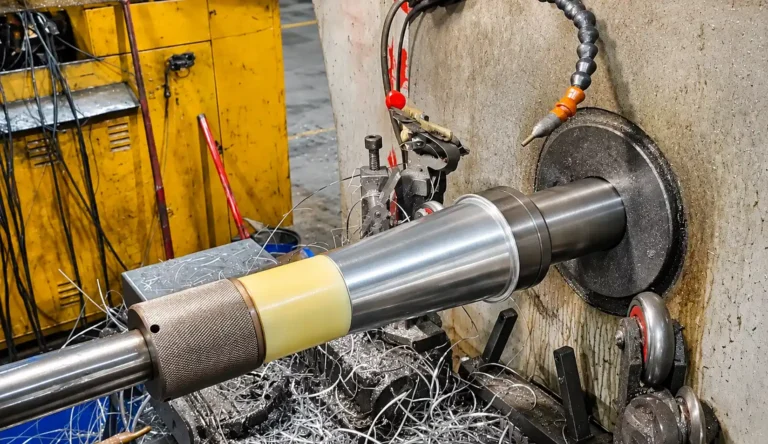

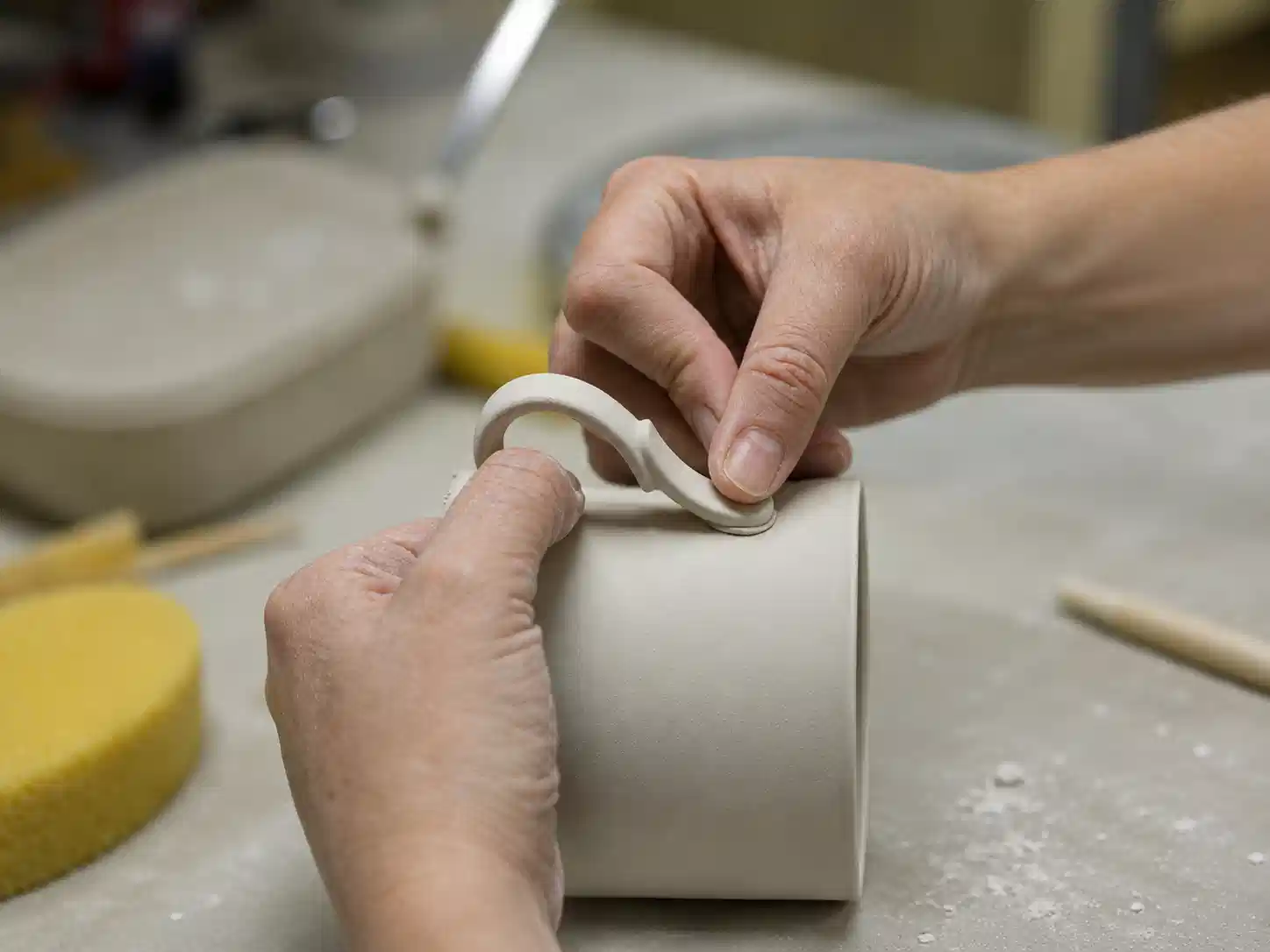
Ceramic Mug forming decisions can feel confusing when a buyer only wants a reliable product that looks like the approved sample. The problem is that “better process” is the wrong starting point. If the forming method does not match the shape, volume, and quality target, small risks can become cost, delay, and rework.
Slip casting and roller forming are two common ceramic mug forming methods, but neither is universally better. Slip casting usually suits complex shapes, special handles, irregular bodies, and flexible designs.1 Roller forming usually suits round, consistent mug bodies and larger-volume production.2 Buyers should compare shape, quantity, wall thickness, hand feel, tooling cost, lead time, and mass-production consistency before choosing.
![Ceramic Mug slip casting and roller forming comparison]https://mugbabydrinkware.com/wp-content/uploads/2026/11/Slip-Casting.webp "Ceramic Mug forming method comparison")
In OEM/ODM project discussions, I usually see buyers focus on unit price first. That is understandable. However, the forming method affects much more than price. It can influence mug weight, rim feel, shape tolerance, sample accuracy, production stability, and how confidently a supplier can repeat the design.
What Does Ceramic Mug Forming Actually Decide?
Choosing a Ceramic Mug forming method is not only a factory-side technical decision. It becomes a buyer-side product decision. If the method is mismatched, the mug may still be producible, but the production team may struggle with consistency, appearance, or cost control.
The forming method decides how the mug body is shaped before firing. Slip casting uses liquid clay poured into molds, while roller forming shapes clay against a rotating mold. For buyers, the key effects are shape possibility, wall thickness control, weight, roundness, tooling needs, production efficiency, and sample-to-mass-production consistency.
Why buyers often ask the wrong question
Many overseas buyers ask me, “Which process is higher quality?” I understand the question, but I usually reframe it. A better question is:
“Which forming method best matches this mug design, order quantity, and production risk?”
Quality does not come from the forming method alone. It also depends on mold condition, clay body suitability, drying control, firing control, inspection standards, and supplier experience.3 A good factory can produce poor results if the method does not suit the shape. A suitable forming method can also perform badly if production control is weak.
For ceramic mug sourcing, forming mainly affects these buyer-visible areas:
| Buyer concern | Why forming method matters |
|---|---|
| Mug shape | Some shapes are easier to repeat with one method than another |
| Wall thickness | The process can affect thickness distribution and weight4 |
| Rim feel | The mouth rim needs consistency and comfort |
| Body roundness | Round mugs often benefit from stable forming methods |
| Design flexibility | Unusual forms may require more flexible mold-based forming |
| Unit cost | Cost depends on tooling, labor, output, yield, and rework |
| Lead time | Mold making and production rhythm can change timelines |
| Mass-production risk | The approved sample must be repeatable at scale |
What slip casting means in practical sourcing terms
Slip casting uses a liquid clay mixture, often called slip, which is poured into a mold. The mold absorbs water from the slip, and a clay layer forms against the mold wall.5 After a suitable wall thickness forms, excess slip is poured out. The piece is then dried and processed further.
For a buyer, slip casting is often discussed when the mug has:
- A special body shape
- A non-standard silhouette
- More sculptural details
- A design that cannot be easily formed by rotation
- A custom project with appearance flexibility
Slip casting can be useful when the design is not a simple round cylinder. However, buyers should not assume that slip casting automatically means premium quality. It can involve more manual control, and that means supplier experience and inspection discipline matter.
What roller forming means in practical sourcing terms
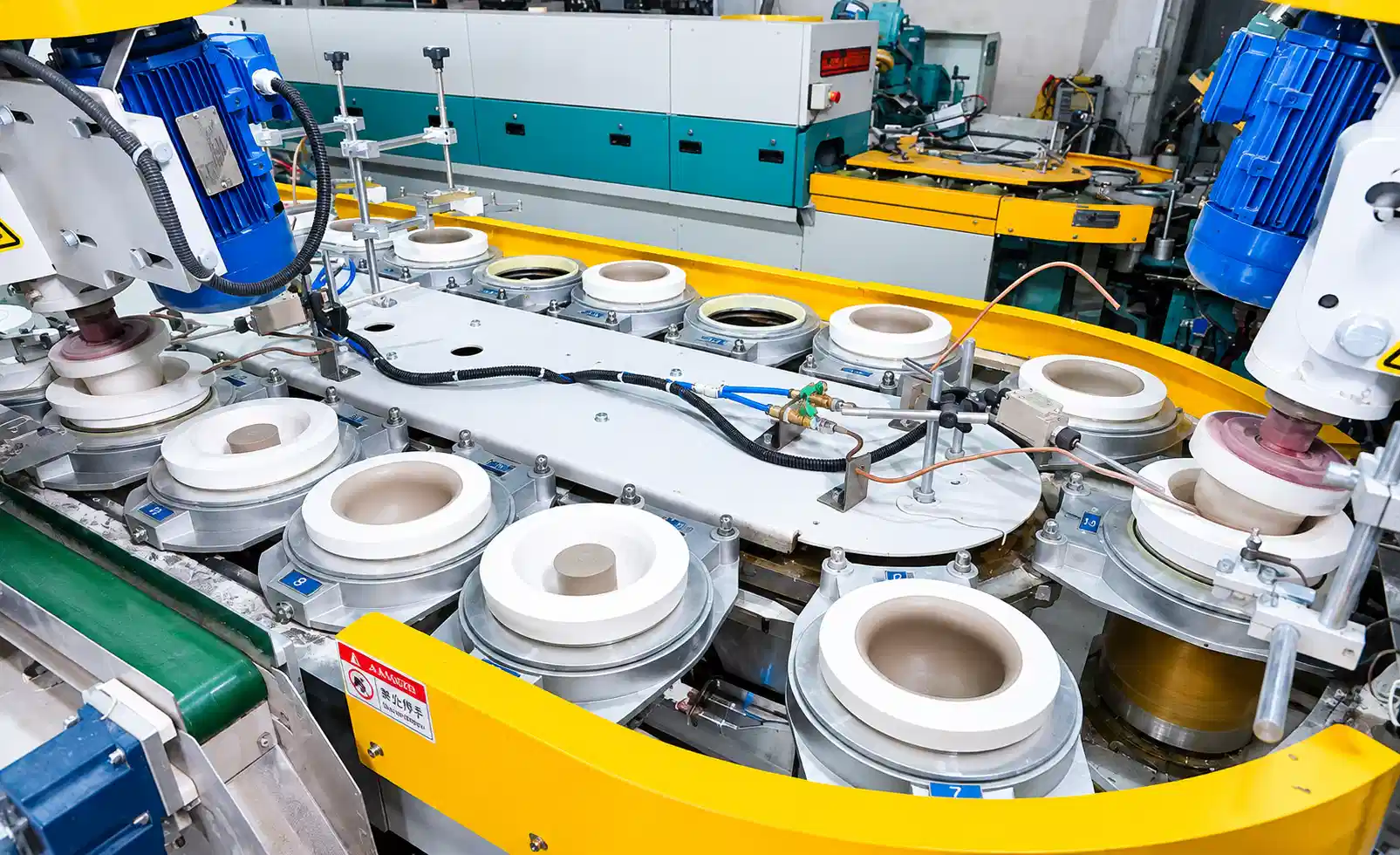
Roller forming usually uses plastic clay placed into or onto a rotating mold while a forming tool shapes the mug body.6 It is commonly considered for round, symmetrical ceramic mug bodies. The process can support efficient production when the shape is suitable and the volume justifies the setup.
For a buyer, roller forming is often discussed when the mug has:
- A round body
- A standard cylinder or tapered shape
- A stable wall profile
- A larger-volume production plan
- A strong need for repeatability
However, roller forming is not the answer for every mug. If the shape is too irregular or the design needs special contours, forcing it into roller forming may create compromises. In project discussions, I prefer to review the 3D shape, sample target, and order plan before suggesting a forming direction.
When Is Slip Casting Better for a Ceramic Mug?
Slip casting can be attractive when a Ceramic Mug design has complexity, special contours, or a shape that is difficult to create with a rotational forming process. The risk appears when buyers expect the same cost and production rhythm as a simple round mug.
Slip casting is often better for a ceramic mug when design flexibility matters more than maximum forming efficiency. It suits special shapes, irregular bodies, sculptural features, and custom concepts. Buyers should evaluate mold quality, wall thickness expectations, manual finishing needs, sample repeatability, and supplier experience before confirming slip casting for bulk production.
Where slip casting fits best
Slip casting is often selected because it gives more freedom in shape. If a mug body is not a clean round form, the supplier may need a method that follows the mold more closely. This can be especially relevant for OEM/ODM projects where the brand wants the mug to stand apart on a shelf.
Common examples include:
- Mugs with square, oval, or faceted bodies
- Mugs with relief details or raised patterns
- Animal, character, or novelty-shaped mugs
- Irregular handmade-look bodies
- Special promotional drinkware shapes
- Designs where the body is part of the brand story
I have seen buyers bring beautiful concept drawings that look simple on a screen but become difficult in production. A small curve, a narrow waist, or a sharp corner can change the forming conversation.7 In those discussions, slip casting often becomes relevant because the mold can reproduce shapes that are not easy to form by roller.
Buyer-visible strengths of slip casting
Slip casting can support design expression. That is its biggest sourcing value. It can also help when the mug shape has undercuts or surfaces that require mold-based definition, although the exact feasibility should always be confirmed by the factory’s technical team.
Key buyer benefits may include:
-
More shape flexibility
Slip casting can be suitable for custom silhouettes and non-round bodies. -
Better fit for special designs
Novelty mugs, sculptural mugs, and decorative bodies may need this method. -
Useful for lower or mixed-volume custom projects
The cost logic depends on the project, but slip casting may be considered when design flexibility is more important than high-speed output. -
Closer expression of complex samples
If the approved sample has unusual curves, slip casting may help preserve the intended visual effect.
Buyer risks to check before approval
Slip casting also has risks. Buyers should not treat it as a magic solution. Since more manual steps may be involved, the buyer should pay close attention to repeatability.8
Important checks include:
| Check item | Buyer question |
|---|---|
| Wall thickness | Will the mug feel too heavy or too light compared with the sample? |
| Rim consistency | Will the drinking edge feel smooth and even? |
| Shape repeatability | Will bulk pieces stay close to the approved sample? |
| Mold wear | How will the supplier control long-run consistency? |
| Finishing marks | Will hand-finishing create visible variation? |
| Handle fit | Will the handle position and angle remain consistent? |
A practical approach is to ask the supplier for pre-production samples and agree on measurable standards where possible. For example, buyers can discuss approximate weight range, height tolerance, diameter tolerance, rim feel, and visual inspection criteria. These do not need to become academic specifications, but they should be clear enough for procurement and quality teams.
How I explain slip casting to buyers
When a buyer asks me whether slip casting is “higher-end,” I normally say: it is more design-flexible, not automatically higher quality. If the brand wants a special form, slip casting may be the correct route. If the brand wants a simple round mug at stable volume, it may not be the most efficient route.
That difference matters because purchasing teams often compare quotations line by line. A slip-cast mug may involve different mold needs, drying behavior, manual trimming, and inspection effort.9 The unit price only tells part of the story. The better sourcing question is whether the process protects the approved design during mass production.
When Is Roller Forming Better for a Ceramic Mug?
Roller forming can look less exciting than slip casting because it is often used for simpler round forms. However, many commercial Ceramic Mug projects need exactly that: stable shape, comfortable rim, repeatable body, and predictable production planning.
Roller forming is often better for a ceramic mug when the design is round, symmetrical, and suitable for efficient repeated production. It can be a strong choice for standard cylinders, tapered mugs, and large-volume OEM orders. Buyers should still verify tooling, clay suitability, tolerance control, and sample-to-bulk consistency with the supplier.
Where roller forming fits best
Roller forming is commonly considered when the mug body is round and repeatable. This includes many everyday mugs sold by brands, retailers, promotional companies, and hospitality suppliers. The process can be suitable when the shape can rotate cleanly and the wall profile can be controlled through the forming tool and mold.
Typical suitable designs may include:
- Straight round mugs
- Slightly tapered mugs
- Coffee mugs with standard cylindrical bodies
- Stackable or semi-stackable round forms, if designed correctly
- Large-volume private-label mug programs
- Projects where body consistency matters more than sculptural detail
In OEM quotation discussions, I usually ask for drawings, target capacity, target weight, and expected quantity. These details help the factory judge whether roller forming is practical. A mug that looks round in a photo may still have details that complicate production.
Buyer-visible strengths of roller forming
Roller forming often appeals to buyers because it supports consistency for suitable shapes. A round mug program usually needs stable dimensions, steady hand feel, and reliable fit with packaging. If a mug needs to sit well in a gift box, match a lid, or align with an existing retail range, consistency becomes important.
Potential strengths include:
-
Good fit for round mug bodies
The method is well aligned with rotational shapes. -
Stable appearance for repeat orders
A standard body can be easier to control across batches when tooling and process control are strong. -
Efficient production for suitable volumes
When the design and order scale match the method, production planning may be more efficient. -
Consistent rim and body profile
Buyers often care about the first touch point: the drinking rim. A stable forming method can help protect that experience.
What roller forming does not solve
Roller forming is not automatically cheaper or faster in every case. The shape must suit the process. Tooling and setup must make sense. The supplier must also manage drying, firing, glaze, and inspection properly. Even a well-formed mug can fail buyer expectations if the approved sample is not clearly defined.
Buyers should be careful when:
- The mug body is not truly round
- The design has sculptural details
- The project quantity is too low for the setup logic
- The brand expects a handmade irregular look
- The mug has special thickness or weight targets
- The rim, handle, or capacity must meet strict requirements
A practical evaluation table
| Decision factor | Roller forming may fit when… | Buyer caution |
|---|---|---|
| Shape | The body is round or symmetrical | Irregular shapes may need another method |
| Quantity | The order volume supports setup | Very small runs may not benefit |
| Consistency | Repeatability is a priority | Clear tolerances are still needed |
| Weight | The target weight is stable and realistic | Extreme lightness or heaviness needs review |
| Lead time | The shape is standard enough for efficient planning | Tooling and sample approval still take time |
| Branding | The body is a clean base for decoration | Decoration should not hide forming problems |
How I explain roller forming to buyers
I often describe roller forming as a strong option for “commercially stable” mug designs. That phrase is not very technical, but buyers understand it. It means the shape is practical, repeatable, and suitable for bulk production.
For example, a brand may want a 350 ml round mug with a smooth wall, comfortable rim, and consistent weight. In that case, the forming conversation should focus on whether roller forming can meet the approved profile and quality expectations. The buyer should review samples in hand, not only in photos. Weight, rim feel, and balance are difficult to judge from images.
If the mug design is standard, roller forming can support efficient supplier communication. The buyer can define the target by capacity, height, diameter, wall feel, handle comfort, and approved sample. The factory can then evaluate tooling, production flow, and quality checkpoints. This is where procurement, product development, and quality control should work together.
How Should Buyers Compare Ceramic Mug Costs Between the Two Methods?
Cost comparison can become misleading when buyers only compare unit prices. A Ceramic Mug quotation reflects more than forming labor. It may include mold cost, sample cost, production yield risk, order volume, finishing effort, lead time pressure, inspection requirements, and rework exposure.
Buyers should compare slip casting and roller forming costs by looking at total project cost, not only unit price.10 The right comparison includes tooling, MOQ, sample development, production efficiency, defect risk, manual finishing, quality inspection, packaging fit, lead time, and how closely bulk production can match the approved sample.
Why unit price alone is not enough
In real quotation discussions, buyers sometimes ask, “Can you make it cheaper with another process?” Sometimes the answer is yes. Sometimes the answer is no. Often, the more useful answer is: “We need to check whether another process can still make the same mug.”
A lower unit price can become expensive if the forming method causes problems later. For example:
- The mug body may drift away from the approved sample.
- The wall thickness may feel wrong.
- The rim may need extra finishing.
- The body may not fit the planned packaging.
- The order may require more sorting or rework.
- The lead time may become harder to control.
For buyers, the true cost is the cost of delivering an acceptable product on time. That includes visible quality, internal approvals, customer claims, and repeat-order confidence.
Total cost factors to compare
| Cost factor | Slip casting consideration | Roller forming consideration |
|---|---|---|
| Mold/tooling | May support complex shapes but requires careful mold planning | Often suitable for round forms with process-specific tooling |
| MOQ | Depends on design, supplier, and production plan | Often more logical for larger repeated orders |
| Labor | May involve more manual control and finishing | May be more efficient for suitable round shapes |
| Sample development | Useful for special designs, but sample approval must be strict | Useful for confirming dimensions, rim, and weight |
| Rework risk | Shape complexity can increase finishing attention | Process mismatch can create shape compromise |
| Lead time | Complex molds and drying behavior may affect schedule | Setup and production planning still need confirmation |
| Bulk consistency | Needs strong process control | Often strong for suitable shapes, but not guaranteed |
Questions I recommend buyers ask suppliers
A good supplier should be able to discuss the forming method in commercial terms, not only technical terms. I recommend buyers ask:
-
Which forming method do you recommend for this design, and why?
The supplier should explain the reason based on shape, quantity, and production control. -
Will bulk production use the same forming method as the approved sample?
This is important. A sample made one way and bulk made another way can create differences. -
What dimensions and weight range can you control in mass production?
Buyers should verify this with pre-production samples and inspection plans. -
What are the main quality risks for this design?
A professional answer should mention possible risks, not only benefits. -
How will you control consistency across the order?
The answer may include mold management, production checks, in-process inspection, and final QC. -
Does this design affect packaging fit or shipping risk?
Shape and thickness can change carton layout, inner box fit, and breakage considerations.
How to make an internal decision
If I were helping a product manager prepare an internal recommendation, I would not simply write “choose slip casting” or “choose roller forming.” I would write a decision note like this:
- Design goal: special shape or standard round body
- Order plan: trial order, seasonal program, or repeat volume
- Quality priority: appearance uniqueness, dimensional consistency, or hand feel
- Cost view: unit price plus tooling, development, inspection, and rework risk
- Supplier view: factory experience with similar mug bodies
- Approval requirement: sample, pre-production sample, and inspection criteria
This makes the decision easier to explain to management or end customers. It also reduces the chance that the buyer chooses a process only because it sounds more advanced.
How Can Buyers Reduce Ceramic Mug Production Risk Before Ordering?
Production risk appears when the buyer, supplier, and quality team do not share the same definition of success. A Ceramic Mug can look acceptable in a quotation photo but feel different in hand, weigh more than expected, or vary from the approved sample.
Buyers can reduce ceramic mug production risk by confirming the forming method early, approving physical samples, defining key tolerances, checking supplier experience, and aligning inspection criteria before bulk production. The safest decision combines design feasibility, commercial cost, and quality control rather than relying on process labels alone.
Start with the physical sample
A physical sample is still one of the most important decision tools. Photos help, but they cannot fully show weight, rim comfort, wall thickness, or balance.11 For drinkware, the hand feel matters because the consumer touches the product every time.
When reviewing a sample, buyers should check:
- Does the mug feel too heavy or too thin?
- Is the rim comfortable for drinking?
- Does the body look symmetrical from different angles?
- Is the handle position natural?
- Does the capacity match the target?
- Does it fit the intended packaging?
- Does it match the brand’s visual standard?
If the sample is approved, buyers should clearly record it as the reference. The supplier and buyer should both understand whether the sample is a design reference, a color reference, a forming reference, or the full approved standard.
Define simple but useful quality points
A ceramic mug project does not always need a highly technical specification sheet. However, it does need clear quality points. I prefer simple standards that procurement and QC teams can actually use.
Useful points may include:
| Quality point | Why it matters |
|---|---|
| Height and diameter | Affects appearance, capacity, and packaging |
| Weight range | Affects hand feel and perceived quality |
| Capacity | Affects product claims and customer expectations |
| Rim smoothness | Affects drinking comfort |
| Body shape | Affects shelf appearance and brand consistency |
| Handle alignment | Affects usability and visual quality |
| Sample match | Protects the approved design |
Buyers should also ask the supplier which points are realistic for the selected forming method. A very tight requirement may increase cost or rejection risk. A very loose requirement may lead to unacceptable variation.12
Review supplier fit, not only process fit
The forming method matters, but supplier fit matters just as much. A supplier should have experience with the chosen method and similar products. Certificates, audits, and compliance documents can support supplier evaluation, but buyers should verify them and confirm they apply to the relevant factory, product type, and order period.
For ceramic drinkware OEM/ODM projects, I suggest buyers review:
- Factory experience with similar mug shapes
- Sample development communication
- Ability to explain forming method selection
- Quality control process
- Inspection standards
- Export experience for the target market
- Responsiveness during quotation and sampling
- Willingness to discuss risks honestly
In our own customer communication, I find that serious buyers appreciate direct risk discussion. A supplier who only says “no problem” may sound convenient at first, but it does not help the buyer plan. A supplier who explains trade-offs can help protect the project.
Frequently Asked Questions
Is slip casting better than roller forming for ceramic mugs?
Slip casting is not universally better. It is often more suitable for complex or irregular mug shapes. Roller forming is often more suitable for round, repeatable mug bodies. The better choice depends on design, quantity, cost target, appearance expectations, and mass-production risk.
Is roller forming always cheaper for a ceramic mug?
Roller forming is not always cheaper. It can be efficient for suitable round shapes and appropriate order volumes, but total cost also depends on tooling, MOQ, sample development, quality control, lead time, and rework risk. Buyers should compare total project cost, not only unit price.
Which method gives better wall thickness consistency?
The answer depends on the mug design, tooling, material, and supplier control. Roller forming may support stable profiles for suitable round shapes. Slip casting may vary more with complex designs and manual control. Buyers should verify thickness, weight, and rim feel with physical samples.
Can the same ceramic mug design be made by both methods?
Some simple designs may be possible with both methods, but the final result may not be identical. Shape, weight, rim feel, tooling cost, and production efficiency can change. Buyers should ask the supplier to explain the trade-offs before changing the forming method.
What should I confirm before approving mass production?
Buyers should confirm the forming method, approved physical sample, dimensions, weight range, capacity, rim feel, handle alignment, packaging fit, and inspection criteria. They should also ask whether mass production will use the same method as the approved sample.
Conclusion
Ceramic Mug forming is a sourcing decision, not a contest between two “better” processes. Slip casting often fits complex, special, or design-led mugs. Roller forming often fits round, repeatable, higher-volume mug bodies. Buyers should compare shape, quantity, tooling, hand feel, consistency, and total project risk before deciding. If you are developing a custom ceramic mug program, I can help review your design direction and discuss the most practical OEM/ODM production route before sampling.
"Slip casting", https://en.wikipedia.org/wiki/Slip_casting. Ceramics processing literature identifies slip casting as a mold-based forming method commonly used for intricate or complex ceramic shapes. Evidence role: general_support; source type: research. Supports: A ceramics processing source should support that slip casting is commonly used for complex or intricate ceramic shapes made through molds.. Scope note: The source may support the general capability of slip casting for complex shapes but may not specifically evaluate ceramic mugs or handles. ↩
"Pottery", https://en.wikipedia.org/wiki/Pottery. Ceramic forming references associate roller forming with rotationally symmetric ware and repeated production where a mold and forming head define a consistent profile. Evidence role: general_support; source type: research. Supports: A ceramics manufacturing source should indicate that roller forming is used for rotationally symmetric ceramic ware and can support efficient repeated production.. Scope note: The support is contextual because production volume thresholds depend on tooling, factory equipment, and product design. ↩
"Ceramics | Office of Environmental Health and Safety", https://ehs.princeton.edu/health-safety-the-campus-community/art-theater-safety/art-safety/ceramics. Ceramics engineering literature treats finished-ware quality as the result of interacting material, forming, drying, firing, and quality-control variables rather than a single forming choice. Evidence role: expert_consensus; source type: paper. Supports: A ceramics engineering paper or review should show that ceramic quality is influenced by raw materials, forming, drying, firing, and inspection or process control.. Scope note: The source may discuss ceramics generally rather than ceramic mugs specifically. ↩
"The effect of wall thickness distribution on mechanical ...", https://pmc.ncbi.nlm.nih.gov/articles/PMC5101989/. Ceramic forming studies show that forming parameters influence wall-thickness distribution; because weight depends on geometry and material density, thickness variation can affect finished article mass. Evidence role: mechanism; source type: paper. Supports: A technical source should support that forming parameters and methods affect wall thickness, which in turn affects product weight.. Scope note: The source may address ceramic forming mechanisms broadly rather than mug-specific weight targets. ↩
"Slip casting", https://en.wikipedia.org/wiki/Slip_casting. A ceramics education source describes slip casting as the formation of a ceramic body when liquid clay slip is poured into a porous mold that removes water and leaves a clay layer against the mold surface. Evidence role: mechanism; source type: education. Supports: A university or educational ceramics source should explain that slip casting uses clay slip poured into a porous mold, where water absorption forms a solid clay layer.. ↩
"Steps in the Ceramics Process", https://gcc.glendale.edu/ceramics/ceramicprocess.html. Ceramics manufacturing references describe roller forming as a process in which plastic clay is shaped in a rotating mold by a profile roller or forming head. Evidence role: definition; source type: education. Supports: A ceramics manufacturing reference should define roller forming or roller-head forming as shaping plastic clay against a rotating mold with a profile tool.. ↩
"Failure of Martensitic Sharp Edges: A Micro-Mechanical ...", https://dspace.mit.edu/handle/1721.1/143927. Ceramic design guidance notes that geometry and section transitions influence forming feasibility, mold design, drying behavior, and defect risk. Evidence role: mechanism; source type: education. Supports: A ceramic design or manufacturing source should explain that part geometry, including corners, curves, and section changes, affects forming and mold feasibility.. Scope note: The source may provide design principles rather than direct evidence from ceramic mug production. ↩
"Ceramics-Unit-9-Production-Molds.pdf - Colorado 4-H", https://co4h.colostate.edu/wp-content/uploads/sites/27/2026/03/Ceramics-Unit-9-Production-Molds.pdf. Manufacturing quality literature links manual operations with potential process variation and emphasizes repeatability controls where operator-dependent steps are present. Evidence role: general_support; source type: research. Supports: A manufacturing or ceramics quality source should support that processes with more manual operations require stronger controls to maintain repeatability.. Scope note: The source would support the general quality-control principle; it may not quantify repeatability risk for slip-cast mugs. ↩
"Ceramics-Unit-9-Production-Molds.pdf - Colorado 4-H", https://co4h.colostate.edu/wp-content/uploads/sites/27/2026/03/Ceramics-Unit-9-Production-Molds.pdf. Educational ceramics process descriptions present slip casting as a sequence involving mold use, drainage or wall build-up, drying, finishing, and subsequent quality-sensitive processing. Evidence role: general_support; source type: education. Supports: A ceramics process source should support that slip casting includes mold preparation, controlled drying, finishing or trimming, and quality inspection considerations.. Scope note: The source may describe typical studio or industrial practice and may not specify the inspection burden for commercial mugs. ↩
"The Influence of Price on Purchase Intentions - PMC", https://pmc.ncbi.nlm.nih.gov/articles/PMC7911682/. Procurement literature on total cost of ownership argues that supplier and process choices should account for direct price as well as indirect costs such as tooling, quality, logistics, delays, and rework. Evidence role: expert_consensus; source type: paper. Supports: A procurement or supply-chain paper should support evaluating purchases by total cost of ownership, including direct and indirect costs, rather than unit price alone.. Scope note: The support is a general procurement principle and not specific to ceramic mug forming. ↩
"Seeing as Feeling? The Impact of Tactile Compensation ...", https://pmc.ncbi.nlm.nih.gov/articles/PMC10813092/. Research on haptic and multisensory product evaluation shows that touch contributes information about weight, texture, comfort, and handling that visual inspection alone cannot fully provide. Evidence role: general_support; source type: paper. Supports: A haptics or product-experience study should support that tactile and weight-related attributes require physical interaction and are not fully conveyed by images.. Scope note: The evidence would support the sensory-evaluation principle generally, rather than testing ceramic mugs specifically. ↩
"Cost of quality tradeoffs in manufacturing process and", https://dspace.mit.edu/bitstream/handle/1721.1/76133/821686496-MIT.pdf?sequence=2. Manufacturing engineering literature describes tolerance selection as a cost-quality trade-off: tighter tolerances generally require greater process control and may increase cost or rejection, while looser tolerances permit wider product variation. Evidence role: expert_consensus; source type: paper. Supports: A manufacturing engineering source should support that tighter tolerances can raise cost or rejection rates, while looser tolerances allow greater variation.. Scope note: The source would establish the engineering principle and may not provide ceramic-mug-specific tolerance data. ↩