
Fettling and sponging may seem like minor workshop steps, but they often determine whether ceramic drinkware feels refined or careless. Buyers may approve a clean sample, then receive bulk goods with rough rims, visible seams, or glaze flaws. These steps are practical controls that reduce defects before firing and finishing.
Fettling and sponging matter in ceramic production because they remove excess clay, smooth surfaces, clean seams, and prepare drinkware bodies for stable glazing and finishing. For bulk OEM/ODM orders, these steps help control visible quality, hand feel, sample-to-bulk consistency, rework pressure, and the total cost of quality.
Buyers often focus on shape, logo, color, and packaging. While important, the small finishing steps before glazing often decide whether the final mug, cup, or tumbler looks premium in the customer’s hand. Fettling and sponging should be treated as buyer-facing quality topics, not just factory-floor terms.
What Are Fettling and Sponging in Ceramic Production?
Fettling and sponging are easy to underestimate because they happen before the product looks finished. Early imperfections often become more visible later.1 If seams, burrs, or particles remain on the body, glazing and firing can make them harder to correct.
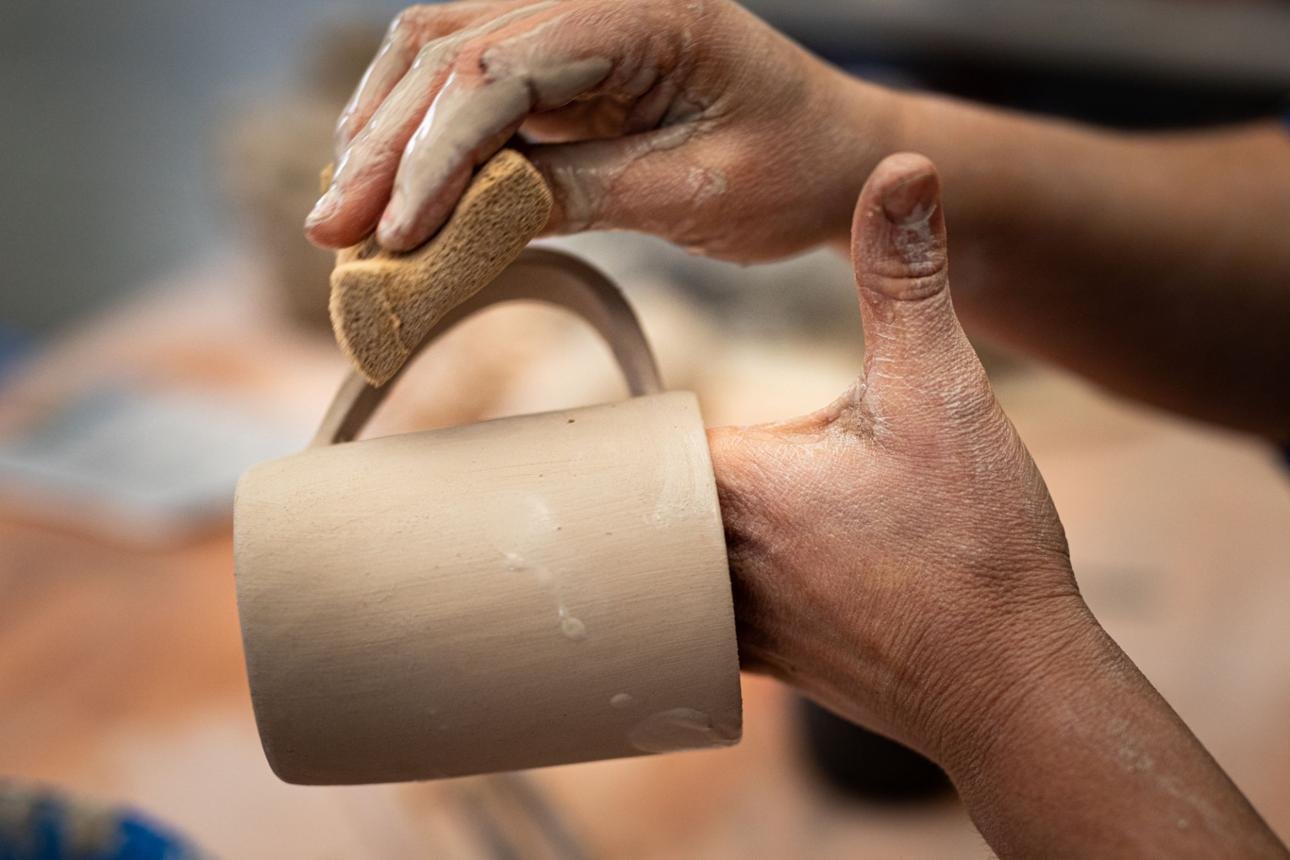
Fettling removes unwanted clay from molded or formed ceramic pieces, including seams, mold lines, burrs, excess material, and rough edges.2 Sponging cleans and smooths the body surface with moisture and a sponge.3 Together, they prepare ceramic drinkware for cleaner glazing, better touch, and more consistent bulk appearance.
Fettling is mainly about removal. Sponging is mainly about refinement. Both are part of surface preparation, solving different problems.
Fettling: Removing What Should Not Stay
Fettling is used after forming, casting, pressing, or molding. A ceramic body may come out with small raised lines, uneven edges, extra clay around the foot, or marks near the handle joint. These issues may look minor at the greenware stage but can become visible defects after glaze and firing.
Common fettling targets include:
- Mold seams on the body wall
- Clay burrs around rims and foot rings
- Extra material near handle attachment points
- Uneven trimming around the base
- Sharp or rough edges affecting hand feel
- Small surface protrusions disturbing glaze flow
For a mug, the rim and handle area are especially important. A customer touches the rim with the mouth and holds the handle every time. If those areas feel rough, the whole product feels cheap, even when the logo printing and packaging look good.
Sponging: Cleaning and Smoothing the Surface
Sponging follows or supports fettling. Workers use a damp sponge to clean dust, soften hard lines, and smooth the ceramic body surface. This step helps remove loose particles that may later create glaze defects.4
Buyers rarely ask about sponging directly but often complain about the problems it helps prevent:
- Pinpoint surface roughness
- Uneven glaze texture
- Small particles under glaze
- Inconsistent hand feel between pieces
- Visible lines after decoration
- Rough areas near rims, handles, or foot rings
Fettling vs. Sponging at a Glance
| Process | Main Purpose | Typical Area | Buyer-Facing Result |
|---|---|---|---|
| Fettling | Remove excess clay and rough material | Seams, rims, foot rings, handle joints | Cleaner shape and safer hand feel |
| Sponging | Clean and smooth the body surface | Full surface, edges, detailed areas | Smoother glaze and more refined appearance |
| Both Together | Prepare the ceramic body before glazing | Entire drinkware piece | Better sample-to-bulk consistency |
Machine forming does not eliminate the need for these steps.5 Machines help with speed and consistency, but ceramic pieces can still carry small irregularities. Fettling and sponging allow the factory to correct those issues before later stages make correction more expensive.
Why Do Fettling and Sponging Affect Ceramic Drinkware Quality?
Fettling and sponging affect ceramic drinkware quality because buyers and end users judge drinkware by what they see and touch. A small seam on a handle or a rough foot ring can change the perceived value of the product, even when the cup technically functions.
These steps improve rim smoothness, reduce visible mold lines, clean surface particles, and prepare the body for more even glaze coverage. They do not guarantee perfect quality alone but reduce common appearance and touch defects before decoration, firing, and final inspection.
The Customer Feels the Product Before Reading the Specification
A ceramic mug may have the right capacity, logo, and Pantone color. Still, if the rim feels sharp or the handle joint has a raised seam, the customer notices immediately.
Touch quality matters because the product has direct contact with the hand and mouth.6 Buyers should pay special attention to:
-
Rim comfort
The rim should feel smooth and consistent. A rough rim can make the product feel unsafe or low-grade. -
Handle joint finishing
Handle joints often show uneven clay build-up. Weak fettling can leave visible lumps or seams. -
Foot ring smoothness
A rough foot ring can scratch tables or feel unfinished during handling.7 -
Body surface cleanliness
Surface particles may show through glaze or create small bumps after firing. -
Decoration area stability
Logos, decals, or prints need a stable surface. Poor smoothing can affect the final look.
Quality Is Often Lost in Small Areas
Large surfaces are easier to inspect visually. Small transition areas create more risk. For example, the curve where the handle meets the mug body can hide extra clay. The inner rim can retain tiny burrs. The bottom edge can feel rough even when the outer wall looks clean.
That is why buyers should inspect samples with both eyes and hands. During pre-production sample review, key questions include:
- Does the rim feel smooth all around?
- Is the seam line still visible after finishing?
- Are handle joints clean and symmetrical?
- Does the foot ring feel stable and smooth?
- Does the surface show particles under glaze?
- Is the approved sample realistic for bulk production?
Fettling and Sponging Support Later Processes
Ceramic production includes forming, drying, glazing, firing, decoration, inspection, and packing. Fettling and sponging sit before some of the most visible finishing stages. When these early steps are weak, later processes may expose the problem.
For example:
| Early Issue | Later Result | Buyer Impact |
|---|---|---|
| Clay burr near rim | Rough glazed edge | Poor mouth feel and complaints |
| Visible mold seam | Line under glaze | Lower perceived quality |
| Dust on body surface | Small glaze bump | Cosmetic defect |
| Uneven handle joint | Distorted appearance | Sample-bulk mismatch |
| Rough foot ring | Scratching risk | Higher rejection in inspection |
Fettling and sponging are practical safeguards, protecting the finish that buyers sell to customers.
How Do Fettling and Sponging Reduce Bulk Order Risk?
Fettling and sponging reduce bulk order risk by controlling small defects before they multiply across thousands of pieces. In sample development, one skilled worker can make a piece look excellent. In bulk production, the challenge is repeating that finish with stable workmanship and inspection standards.
Why Sample Approval Is Not Enough
A pre-production sample is important, but it is not the same as bulk control. Samples are often made with extra care. Bulk goods require repeatable process discipline.8
A good sample review should include:
- Visual inspection under normal light
- Hand-feel inspection around the rim and handle
- Checking the base and foot ring
- Comparing multiple pieces, not just one perfect sample
- Confirming which finishing details are critical for bulk production
Rework Becomes Harder After Glazing and Firing
The earlier a defect is found, the easier it is to correct.9 A rough greenware edge can be finished before glazing. A visible seam under fired glaze is much harder to repair. In many cases, the piece must be downgraded, reworked with limitations, or rejected.
Useful buyer questions include:
- Where do you inspect ceramic bodies before glazing?
- How do you control rim and foot ring smoothness?
- How do you train workers for handle joint finishing?
- Do you compare bulk pieces to approved samples during production?
- What defects are removed before glazing instead of after firing?
Bulk Risk Comes From Repetition
If one mug has a rough foot ring, that may be an isolated issue. If the same roughness appears across several cartons, it suggests a process control problem. Repeated defects affect acceptance rate, delivery timing, and brand reputation.
| Risk Area | Weak Process Signal | Possible Bulk Result |
|---|---|---|
| Rim finishing | Sharp or uneven touch | Customer complaints |
| Seam removal | Visible line after glaze | Lower shelf appeal |
| Surface cleaning | Dust or particles remain | Glaze bumps |
| Handle finishing | Lumps near joint | Inconsistent appearance |
| Foot ring smoothing | Rough base | Table scratches or rejection |
Fettling and sponging reduce these risks by addressing defects before they become locked into the finished product.
Why Is Machine Forming Not Enough Without Fettling and Sponging?
Machine forming improves ceramic production efficiency but does not remove every small irregularity. Buyers sometimes assume machine-made drinkware should be automatically consistent. Molded or shaped ceramic pieces can still carry seams, burrs, and surface marks before drying, glazing, and firing.
Machines help with:
- Basic shape control
- Production speed
- Dimensional repeatability within process limits
- Lower dependence on full hand-forming
- Better scalability for large orders
But machines do not automatically solve:
- Surface particles
- Mold seam visibility
- Burrs at rims or bases
- Uneven handle transitions
- Small dents or rough spots
Manual Finishing Is Still a Quality Control Point
Fettling and sponging act as a bridge between forming and finishing. They allow correction of what the forming process leaves behind. Buyers should ask suppliers about seam removal, rim smoothness, and surface cleaning.
Over-Finishing Can Also Be a Problem
Excessive fettling can distort a rim or change a foot ring. Over-sponging can soften details or create uneven moisture on the surface.10 Finishing should be skilled, controlled, and matched to the product design.
What Should Buyers Check About Fettling and Sponging Before Placing Orders?
Buyers should check fettling and sponging controls before placing ceramic drinkware orders because small finishing gaps can become shipment-level problems. The approved sample may look good, but bulk production needs written standards, clear inspection points, and realistic tolerance for handmade or process-based variation.
A Practical Buyer Checklist
| Checkpoint | What to Look For | Why It Matters |
|---|---|---|
| Rim | Smooth, even, no sharp points | Mouth contact and safety perception |
| Handle joint | Clean transition, no lumps | Visual quality and comfort |
| Mold seam | Removed or minimized | Premium appearance |
| Foot ring | Stable and smooth | Table contact and handling |
| Body surface | No obvious particles or roughness | Glaze and decoration stability |
| Sample comparison | Bulk pieces match approved finish level | Reduces dispute risk |
| Pre-glaze inspection | Defects removed early | Lowers rework pressure |
Define Acceptable and Unacceptable Defects
Buyers can define issues in plain language:
- No sharp rim edges when touched by hand
- No visible seam line on the front-facing body area
- Handle joint should be smooth and free from obvious clay build-up
- Foot ring should not scratch a normal tabletop under normal handling
- Surface should be clean enough for approved glaze appearance
Ask About Inspection Timing
Final inspection is necessary, but it is not enough. If defects are discovered only after firing, options are limited. Good process control includes earlier checks.
How Can a Supplier Show Strong Fettling and Sponging Control?
A supplier can show strong fettling and sponging control by making the process visible, measurable, and connected to buyer expectations. If a factory treats these steps as casual labor, quality may depend too much on individual workers. If the factory manages them as inspection-linked controls, bulk consistency improves.
Look for Standards That Workers Can Actually Use
Good standards may include:
- Approved sample placed near production reference area
- Defect boards showing unacceptable seams, burrs, and rough rims
- Work instructions for high-risk areas such as handles and foot rings
- Supervisor checks at defined intervals
- Sorting rules for pieces that cannot be corrected
Evaluate Communication, Not Only Equipment
A factory should explain how it will protect the approved sample standard during bulk production. Useful supplier responses sound like this:
“We will compare bulk pieces with the approved sample before glazing. We will pay special attention to rim smoothness, handle joints, and foot rings.”
Weak responses sound like this:
“Do not worry. Our quality is good.”
Match Process Control to Product Positioning
Not every ceramic drinkware order has the same quality level, price target, or finishing requirement. Buyers can help by sharing:
- Target market and sales channel
- Expected retail price level
- Critical visual areas
- Logo and decoration requirements
Fettling and sponging control is about managing realistic variation so the finished goods meet the buyer’s approved standard and customer expectations.
Frequently Asked Questions
Are fettling and sponging only cosmetic steps?
No. They improve appearance but also affect touch quality, glaze stability, and defect prevention.
Can good glazing hide poor fettling and sponging?
No. Glazing cannot reliably hide rough shaping, heavy seams, or surface particles.11
Should buyers inspect fettling and sponging during factory audits?
Yes. Buyers should observe rim finishing, handle joint smoothing, foot ring treatment, surface cleaning, and pre-glaze inspection.
Do handmade-style ceramic mugs still need these processes?
Yes. Handmade-style products may allow natural variation but still need comfortable rims, clean surfaces, and controlled roughness.
Do fettling and sponging guarantee ceramic quality?
No. They are important but do not guarantee quality alone. Other production stages also matter.
Conclusion
Fettling and sponging turn small factory-floor actions into visible buyer value. They help control seams, rims, handle joints, foot rings, surface smoothness, and sample-to-bulk consistency in ceramic drinkware production.12 If you are sourcing custom ceramic drinkware, discuss these steps with your supplier early.
"What causes hairline cracks in glazed ceramic pieces?", https://www.facebook.com/groups/maycomudroomsociety/posts/2786130371765617/. Ceramic processing literature notes that flaws introduced before glazing or firing can persist through later stages and appear as visible surface defects in the fired product. Evidence role: mechanism; source type: research. Supports: A ceramic processing source should explain that defects or contamination in greenware can remain, develop, or become more apparent after glazing and firing.. Scope note: The source may discuss ceramic products broadly rather than mugs, cups, or tumblers specifically. ↩
"Fettling… meaning to trim or clean the rough edges of a pot. I ...", https://www.instagram.com/reel/C5XjpLOtDHX/?hl=en. A ceramics instructional source defines fettling as the trimming or cleaning of formed clay ware to remove unwanted material such as seams, burrs, or rough edges before subsequent processing. Evidence role: definition; source type: education. Supports: A ceramics education or technical source should define fettling as trimming or removing unwanted clay, seams, or rough edges from ceramic ware before later finishing.. Scope note: The source may describe ceramics generally rather than ceramic drinkware specifically. ↩
"Sponge", https://en.wikipedia.org/wiki/Sponge. Ceramics teaching materials describe the use of a damp sponge to smooth and clean clay surfaces, supporting the characterization of sponging as a surface-refinement step. Evidence role: definition; source type: education. Supports: A ceramics education source should support that damp sponges are used to smooth, clean, or refine clay surfaces during forming or finishing.. Scope note: The source may address studio pottery methods rather than industrial OEM drinkware production. ↩
"Safety Rules for Ceramics", https://www.southtexascollege.edu/academics/visual-arts/safety/ceramics.html. Ceramic glazing references identify dust, debris, or surface contamination before glazing as potential causes of visible glaze defects, supporting the role of surface cleaning in defect prevention. Evidence role: mechanism; source type: education. Supports: A ceramics technical source should support that dust, debris, or surface contamination before glazing can cause fired glaze defects such as bumps, crawling, or roughness.. Scope note: The cited mechanism supports risk reduction, not a guarantee that sponging alone will prevent all glaze defects. ↩
"A Review on Surface Finishing Techniques for Difficult ... - PMC", https://pmc.ncbi.nlm.nih.gov/articles/PMC8838235/. Ceramic manufacturing descriptions of molded or cast ware commonly include post-forming finishing steps, such as trimming or seam removal, indicating that mechanical forming does not by itself complete surface preparation. Evidence role: general_support; source type: education. Supports: A ceramics manufacturing source should show that molded or cast ceramic ware commonly requires trimming, seam removal, or finishing after forming.. Scope note: The source may not specifically compare every type of machine forming used in drinkware factories. ↩
"Consumer Perception of Tactile Packaging", https://repository.rit.edu/cgi/viewcontent.cgi?article=1013&context=japr. Research on haptic perception and consumer evaluation shows that tactile cues contribute to judgments of product quality, providing context for the importance of smooth surfaces on handled drinkware. Evidence role: expert_consensus; source type: paper. Supports: A peer-reviewed haptics or consumer behavior paper should support that tactile information influences product perception and quality judgments.. Scope note: The evidence is contextual because it concerns consumer touch perception generally rather than ceramic mugs specifically. ↩
"Protecting table surfaces from scratch marks", https://www.facebook.com/groups/PotteryMaking/posts/3808372912625964/. Ceramics instructional sources advise smoothing or finishing the foot or base of ceramic ware, supporting the claim that rough foot rings can affect handling and contact surfaces. Evidence role: general_support; source type: education. Supports: A ceramics instructional source should support that foot rings or bases are smoothed or finished to reduce roughness and prevent scratching or instability.. Scope note: The source may offer practical studio guidance rather than quantified scratch-risk testing. ↩
"6. Process control— introduction to quality control", https://extranet.who.int/lqsi/sites/default/files/attachedfiles/LQMS%206%207%208%20Quality%20Control.pdf. Quality-management standards emphasize controlled production conditions, monitoring, and defined acceptance criteria, supporting the distinction between a single approved sample and repeatable bulk production control. Evidence role: general_support; source type: institution. Supports: A quality-management standard or institutional source should support that consistent production depends on controlled processes, defined criteria, and monitoring rather than isolated sample approval.. Scope note: The source supports the general quality-control principle rather than proving that all ceramic samples are made with extra care. ↩
"Prevention", https://www.childwelfare.gov/topics/prevention. Quality-management literature on cost of quality distinguishes prevention and appraisal from internal and external failure costs, supporting the principle that earlier detection generally reduces correction burden. Evidence role: expert_consensus; source type: institution. Supports: A quality-management institution should support the principle that prevention and early detection reduce rework, failure costs, and correction difficulty.. Scope note: The principle is general to manufacturing and quality systems, not exclusive to ceramic drinkware. ↩
"Overusing the sponge is a common beginner mistake that is ...", https://www.instagram.com/reel/DVrFR8aCXfs/. Ceramics instruction on clay finishing cautions that excessive water or overworking can alter surface detail and clay consistency, supporting the need for controlled sponging. Evidence role: mechanism; source type: education. Supports: A ceramics education source should explain that excessive water or repeated sponging can alter clay surfaces, soften edges, or affect surface finish.. Scope note: The support is likely based on practical ceramics instruction rather than controlled industrial trials. ↩
"Ceramic glaze defects: causes and solutions", https://www.kerafrit.com/en/blog/ceramic-glaze-defects. Ceramic glazing references explain that surface irregularities and contamination before glazing can remain visible or produce fired defects, supporting the statement that glaze is not a reliable substitute for proper surface preparation. Evidence role: mechanism; source type: education. Supports: A ceramic glazing source should support that surface irregularities and contamination before glazing can remain visible or cause defects after firing.. Scope note: The evidence supports the mechanism generally; some glaze types or decorative effects may visually mask minor irregularities. ↩
"A Review on Surface Finishing Techniques for Difficult ... - PMC", https://pmc.ncbi.nlm.nih.gov/articles/PMC8838235/. Ceramic manufacturing literature treats trimming, cleaning, and surface preparation as process steps that influence fired surface quality and dimensional or visual consistency, supporting the article’s summary of fettling and sponging benefits. Evidence role: general_support; source type: research. Supports: A ceramic manufacturing or materials-processing source should support that finishing operations before glazing and firing influence surface quality, seams, edges, and consistency.. Scope note: The source may support the manufacturing relationship generally rather than quantify the exact improvement in sample-to-bulk consistency for drinkware orders. ↩