
Why Does Ceramic Firing Temperature Matter?
Have you ever wondered why some ceramic mugs are fired at around 1,050°C, while others need temperatures above 1,300°C?
The difference is not just about how hot the kiln gets. Firing temperature plays an important role in determining how a ceramic body develops, including its density, water absorption, strength, and overall performance.1
When sourcing custom ceramic mugs, you may come across terms such as earthenware, dolomite, stoneware, and porcelain. They have different material compositions, firing requirements, and physical characteristics.
At Mugbaby, we have worked with ceramic manufacturing partners for many years. We believe understanding these differences helps buyers make better decisions before starting a custom drinkware project.
In this guide, we will look at what happens during ceramic firing, how temperature affects the finished product, and why water absorption can even become relevant when importing ceramic products.
Different Ceramic Types and Their Firing Temperatures
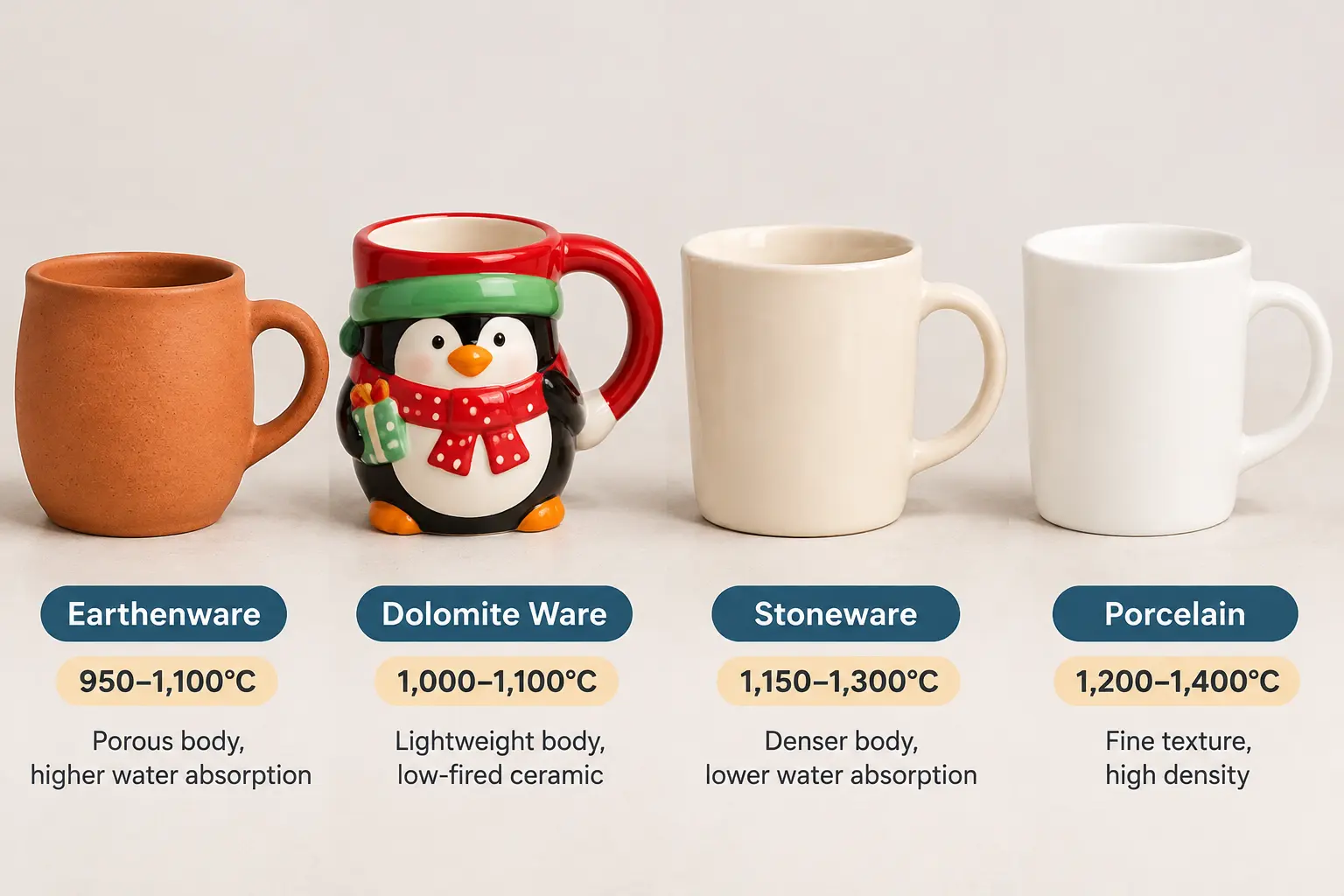
Ceramic products are often grouped according to their body composition, firing temperature, and physical properties.
Here are four types you may encounter when sourcing ceramic mugs.
| Ceramic Type | Typical Firing Temperature | General Characteristics |
|---|---|---|
| Earthenware | 950–1,100°C | Relatively porous, higher water absorption |
| Dolomite Ware | Around 1,000–1,100°C | Often lightweight and low-fired |
| Stoneware | 1,150–1,300°C | Dense body, generally low water absorption |
| Porcelain | 1,200–1,400°C | Fine texture, high density, often white and translucent |
These are indicative ranges, not fixed standards. Actual temperatures depend on the raw material formulation, glaze, kiln conditions, and firing schedule. Some ranges overlap.
Earthenware – Low-Fired Ceramic
Earthenware is generally fired at lower temperatures, commonly around 950–1,100°C.2
At these temperatures, clay particles bond together through sintering, but the body usually does not become fully vitrified.
What does this mean for the finished product?
- Relatively high open porosity.
- Higher water absorption than fully vitrified ceramics.
- A wide range of natural body colors.
- Generally lower density than stoneware and porcelain.
Earthenware can still be used for everyday drinkware when properly glazed and manufactured. However, buyers should pay attention to the body itself, glaze quality, and intended use.
Dolomite Ware – Lightweight, Low-Fired Ceramic
Dolomite ware is an important material category in everyday ceramic and promotional drinkware.
Dolomite is a natural mineral composed mainly of calcium magnesium carbonate.3 In ceramic production, it can be combined with clay and other raw materials to create a ceramic body with particular firing and surface characteristics.
Typical characteristics of low-fired dolomite ceramic include:
- White or light-colored appearance.
- Relatively lightweight body in many formulations.
- Lower firing temperature, often around 1,000–1,100°C.
- Water absorption that can be higher than fully vitrified porcelain.
- Mechanical strength that depends heavily on the formulation and body structure.
One important point: not all dolomite bodies are the same.
Some manufacturers produce lightweight dolomite products, while others use modified formulations to achieve different density and strength levels.
Dolomite is also not a separate universally standardized classification equivalent to porcelain or stoneware.4 It is a mineral-based material description or trade name. Its actual ceramic classification depends on the finished body's properties and the applicable country's rules.
For buyers, the material name alone is not enough. Always check the actual specifications and test results.
Stoneware – Dense and Durable Ceramic
Stoneware is usually fired at approximately 1,150–1,300°C.5
Compared with earthenware, stoneware develops a more vitrified structure during firing. This reduces open porosity and generally improves density and mechanical strength.
Common characteristics include:
- Relatively low water absorption.
- Dense and solid body structure.
- Good everyday durability when properly manufactured.
- Various natural body colors and glaze finishes.
Stoneware is widely used for coffee mugs, dinnerware, and other everyday ceramic products.
It is a practical option for buyers looking for a balance between appearance, durability, and production cost.
Porcelain – Fine Texture and High Density
Porcelain is generally fired at higher temperatures, commonly around 1,200–1,400°C.6
Its formulation typically includes kaolin, feldspar, and quartz.7 During firing, these materials undergo complex transformations that help create a dense and fine ceramic body.
Typical characteristics include:
- High whiteness.
- Fine and smooth texture.
- Low water absorption when properly vitrified.
- High density and hardness.
- Some thin porcelain products can show translucency.
Porcelain is commonly used for premium coffee mugs, hotel tableware, and high-quality giftware.
However, a high firing temperature does not automatically make every porcelain product stronger or more resistant to thermal shock. The body formulation and manufacturing process still matter.
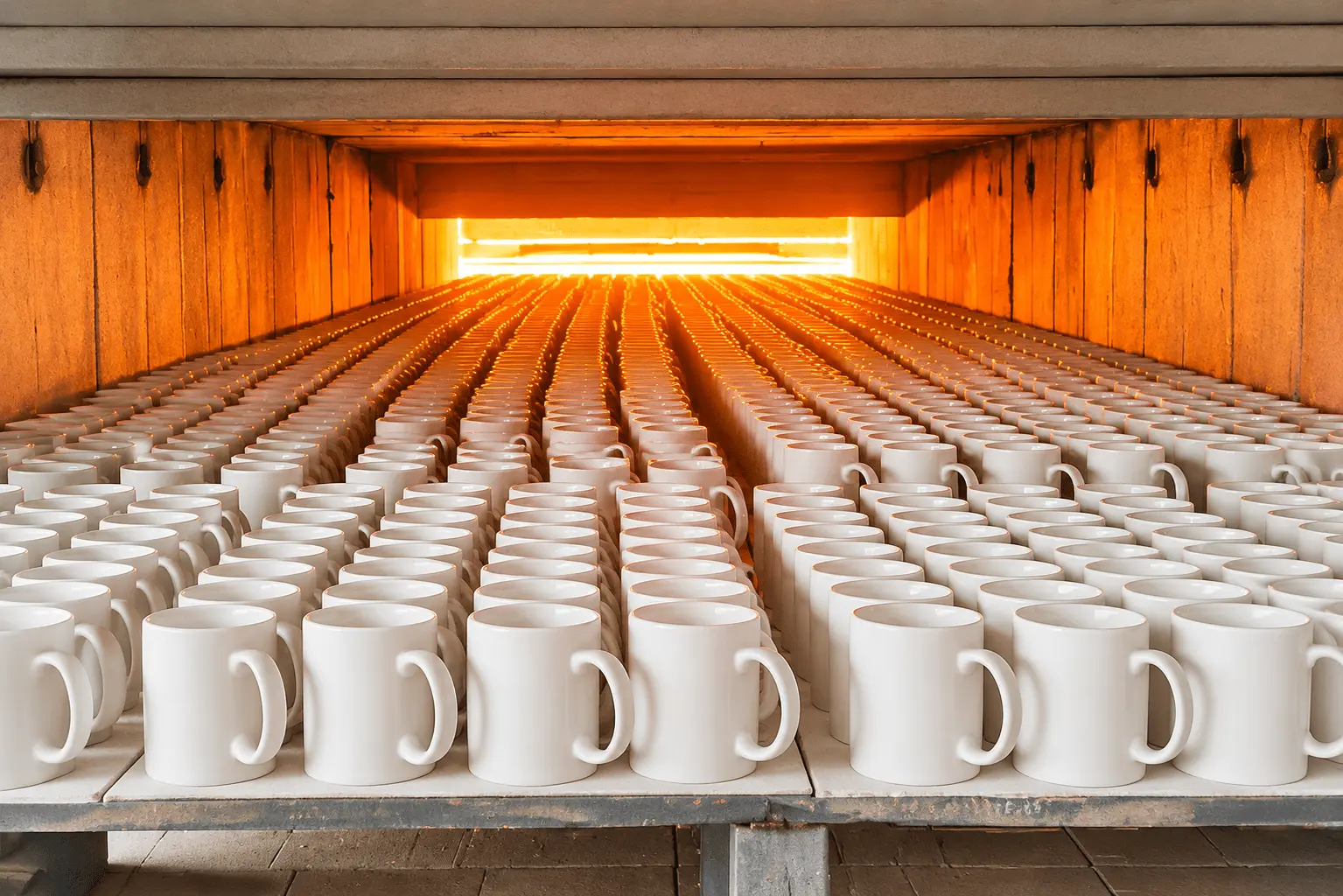
What Happens Inside a Ceramic Kiln?
Firing is much more than simply heating a ceramic cup until it becomes hard.
As the temperature increases, several physical and chemical changes take place inside the ceramic body.
1. Moisture Removal
Residual moisture is removed as the temperature rises. Proper drying before firing is important to reduce the risk of cracking and other defects.
2. Organic Matter Removal
Organic materials in the clay body burn off during heating.
3. Sintering
Ceramic particles begin bonding together at higher temperatures. This process gives the body greater strength and cohesion.
4. Vitrification
As firing continues, glass-forming components develop a liquid phase that helps fill spaces between particles.8
The body becomes denser, and open porosity generally decreases.
5. Shrinkage and Final Maturation
The ceramic body shrinks as it becomes denser. If the firing temperature or holding time is not properly controlled, the product may deform, crack, or develop other defects.
This is why choosing the right firing schedule is just as important as choosing the right raw materials.
How Does Firing Temperature Affect Water Absorption?
Water absorption is one of the important indicators of ceramic body maturity.
In general, as a suitable ceramic body is fired toward its maturation range, sintering and vitrification reduce its open pores. This usually lowers water absorption.
Why does this matter?
A ceramic body with higher open porosity can absorb more water. This may affect its suitability for certain applications, particularly when the body is exposed to moisture over long periods.
For example:
- Earthenware generally has higher water absorption.
- Low-fired dolomite bodies can also have relatively high water absorption.
- Well-matured stoneware usually has lower water absorption.
- Fully vitrified porcelain typically has very low water absorption.
However, there is an important distinction between the ceramic body and its glaze.
A glazed ceramic cup may have a water-resistant surface even if the body underneath is relatively porous. The glaze does not necessarily change the water absorption characteristics of the ceramic body itself.
For manufacturers and buyers, water absorption should be measured through an appropriate test rather than judged by appearance.
How Is Water Absorption Measured?
A commonly used test method for fired ceramic whiteware is ASTM C373.
The basic calculation is:
Water Absorption (%) = [(Saturated Weight − Dry Weight) / Dry Weight] × 100
For example:
| Measurement | Weight |
|---|---|
| Dry ceramic sample | 100 g |
| Saturated ceramic sample | 100.5 g |
| Water absorbed | 0.5 g |
| Water absorption | 0.5% |
This simple example illustrates the calculation. Actual laboratory testing must follow the applicable standard's sample preparation and testing procedures.
ASTM C373 also covers associated properties such as bulk density, apparent porosity, and apparent specific gravity.9
How Does Firing Temperature Affect Strength and Durability?
Firing temperature influences how densely the ceramic particles bond together.
As a body approaches its suitable maturation range, reduced porosity and improved particle bonding can generally contribute to better mechanical strength.
But higher firing temperatures are not always better.
If a body is overfired, it may experience excessive shrinkage, deformation, bloating, or other defects.
The final strength of a ceramic mug also depends on:
- Raw material composition.
- Body density and porosity.
- Forming method.
- Wall thickness and product structure.
- Firing uniformity.
- Existing cracks and manufacturing defects.
For this reason, when comparing ceramic suppliers, we recommend looking at actual product performance rather than choosing a product simply because it was fired at a higher temperature.
Thermal Shock Resistance: Why Do Ceramic Mugs Crack?
For drinkware, thermal shock resistance is particularly important.
Imagine pouring hot coffee into a ceramic mug that has just been taken from a cold environment. The sudden temperature difference causes different parts of the cup to expand at different rates.
This creates internal stress. If the stress exceeds the material's ability to withstand it, cracks may develop.
Several factors affect thermal shock resistance.
1. Coefficient of Thermal Expansion
Materials with different thermal expansion characteristics respond differently to temperature changes.
A lower thermal expansion coefficient can be beneficial, but it is not the only factor.
2. Thermal Conductivity
Heat needs to move through the ceramic body. Uneven temperature distribution can create internal stress.
3. Wall Thickness and Shape
Thick walls, uneven thickness, sharp transitions, and structural differences can affect how temperature spreads through a cup.
4. Body Strength and Microstructure
Porosity, internal defects, and the overall ceramic structure influence how well the body withstands thermal stress. Interestingly, some pores can also help slow crack propagation.10 This means the relationship between porosity and thermal shock resistance is not straightforward.
5. Glaze and Body Compatibility
The glaze and ceramic body must work together. Differences in thermal expansion can create stress after cooling, potentially leading to crazing or other defects.
So, does higher firing temperature mean better thermal shock resistance?
Not necessarily.
A properly formulated and fired ceramic body may perform better than another body fired at a higher temperature. Thermal shock resistance needs to be evaluated through actual testing.
Can Water Absorption Affect Customs Classification and Import Duties?
Here is something many ceramic buyers may not know: water absorption is not only a technical quality indicator. In some markets, it can also play a role in customs classification.
The United States provides a particularly clear example.
Under Additional U.S. Note 5 to Chapter 69 of the Harmonized Tariff Schedule of the United States (HTSUS), specific water absorption limits are used when defining porcelain, stoneware, and earthenware for customs purposes.11
U.S. Customs Definitions of Ceramic Bodies
| Ceramic Classification | U.S. Customs Water Absorption Definition | Other Requirements |
|---|---|---|
| Porcelain / China | Not more than 0.5% | Fired white body, unless artificially colored, and translucent through several millimeters |
| Stoneware | Not more than 3% | Clay is an essential ingredient; generally not white and naturally opaque |
| Earthenware | More than 3% | Fired body containing clay as an essential ingredient |
These are U.S. customs definitions for the relevant tariff headings. They should not be treated as universal ceramic manufacturing standards.
Notice that porcelain is not defined by water absorption alone. The fired body must also meet the applicable color and translucency requirements.
The U.S. tariff note also specifies ASTM C373 as the test method for determining water absorption, with certain provisions concerning specimen weight and glazed surfaces.
This is why a supplier's product name alone may not be sufficient for customs classification.
How Can Classification Affect Import Duties?
Under the U.S. HTSUS, porcelain tableware and other ceramic tableware are classified under different headings.
For example, the 2026 U.S. tariff schedule lists the following general duty rates:12
| Product Description | HTSUS Code | General Duty Rate |
|---|---|---|
| Porcelain mugs and other steins | 6911.10.45.00 | 14% |
| Other ceramic mugs and steins | 6912.00.44.00 | 10% |
| Certain other ceramic cups valued over $5.25 per dozen | 6912.00.45.00 | 4.5% |
These are examples of general Column 1 duty rates, not guaranteed final import costs.
The exact classification can also depend on whether the item is considered a mug, cup, hotelware, or another type of ceramic article, as well as its value and other product details.
A Real Customs Example: Dolomite Ceramic Cups from China
In May 2026, U.S. Customs and Border Protection issued ruling NY N360981 concerning two dolomite ceramic cups imported from China.
The cups were valued at $10.08 per dozen.
CBP agreed with the proposed classification under:
HTSUS 6912.00.4500
The ruling specified a general duty rate of 4.5%.
This is an interesting example because the products were made from dolomite ceramic and were classified as other than porcelain or china.
However, the ruling applied only to the specific products and facts submitted. It does not mean every dolomite mug or cup will automatically receive the same classification.
Does This Mean Lower Water Absorption Always Means Lower Import Duty?
No.
Water absorption is one of the technical characteristics used in U.S. customs definitions, but it does not independently determine the final tariff rate.
Other factors include:
- Whether the product meets the legal definition of porcelain or china.
- Whether the product is a cup, mug, stein, or hotelware.
- Product value and applicable value-based tariff categories.
- The country of origin.
- Additional duties and trade measures.
For example, the United Kingdom also has its own ceramic classification guidance. HMRC lists dolomite among common trade names for earthenware, illustrating why buyers should not assume that customs terminology is identical in every country.
If you are importing ceramic drinkware into the United States, it is worth checking the applicable HTSUS code with your customs broker or requesting a binding ruling from CBP when classification is uncertain.
Also remember that the general duty rates shown above do not include any additional duties that may apply under Chapter 99 or other trade measures.
How to Choose the Right Ceramic Body for Your Drinkware Project
Different ceramic bodies serve different product requirements.
Here is a simple comparison to help you start.
| Your Requirement | What to Consider |
|---|---|
| Lightweight promotional mugs | Dolomite body, mechanical strength, and water absorption |
| Everyday coffee mugs | Stoneware or porcelain, depending on budget and design |
| Premium white ceramic mugs | Porcelain whiteness, texture, and density |
| Decorative ceramic mugs | Body composition, glaze, and decoration compatibility |
| Hot and cold beverage applications | Thermal shock performance and test results |
| Products for the U.S. market | Material classification, water absorption, and customs requirements |
When sourcing custom ceramic mugs, we recommend asking your supplier a few practical questions:
- What type of ceramic body is used?
- What is the recommended firing temperature?
- What is the measured water absorption rate?
- Has the product passed thermal shock testing?
- Is the glaze compatible with the ceramic body?
- What quality checks are performed before shipment?
- Can the supplier provide material specifications and relevant test reports for customs or compliance purposes?
These questions will give you a much better understanding of the product than firing temperature alone.
Frequently Asked Questions
Q1: What is the best firing temperature for ceramic mugs?
There is no single best temperature for all ceramic mugs. It depends on the body formulation, glaze, and intended product performance. Earthenware and dolomite bodies are generally fired at lower temperatures, while stoneware and porcelain require higher temperatures.
Q2: Does higher firing temperature mean better ceramic quality?
No. The correct firing temperature is the one that allows the specific ceramic body to reach its intended maturity. Overfiring can cause deformation, bloating, and other defects.
Q3: Which ceramic type has the lowest water absorption?
Fully vitrified porcelain generally has very low water absorption. However, actual performance depends on the formulation and firing conditions.
Q4: Is dolomite ceramic suitable for everyday drinkware?
It can be suitable for certain everyday applications, depending on its formulation, strength, glaze, and food-contact compliance. Buyers should check actual test results rather than relying on the material name alone.
Q5: Does porcelain have better thermal shock resistance than stoneware?
Not automatically. Thermal shock resistance depends on thermal expansion, strength, thermal conductivity, product geometry, and glaze-body compatibility. Both materials need to be evaluated based on their actual performance.
Q6: Can ceramic water absorption affect U.S. import duties?
Yes. U.S. customs uses water absorption as one of the criteria for distinguishing porcelain, stoneware, and earthenware under Chapter 69. However, other product characteristics and tariff classification rules also apply.
Q7: Is the U.S. water absorption standard used worldwide?
No. The U.S. HTSUS has its own definitions for customs classification. Other countries may use different classification rules and tariff schedules.
Final Thoughts: Choose the Right Body, Not Just the Highest Temperature
Ceramic firing temperature is an important part of manufacturing, but it does not tell the whole story.
Earthenware, dolomite, stoneware, and porcelain each have different characteristics. The right choice depends on what you want your ceramic mug to look like, how you expect it to perform, and where you plan to sell it.
Water absorption is especially worth understanding. It tells us something about the ceramic body's structure and maturity, and in certain markets, it can also become relevant to customs classification and import costs.
At Mugbaby, we work with long-term ceramic manufacturing partners across different production regions in China. We understand that choosing the right ceramic body is the first step toward making a product that meets your expectations.
If you are developing a custom ceramic mug, talk to us about your design and requirements. We can help you explore suitable materials, decoration options, and manufacturing solutions.
"Influence of Firing Temperature on Phase Composition ... - PMC", https://pmc.ncbi.nlm.nih.gov/articles/PMC8585132/. A materials science source explains that firing temperature controls sintering and vitrification in ceramic bodies, which in turn affects porosity, density, water absorption, and mechanical strength. Evidence role: mechanism; source type: education. Supports: A source should explain how firing temperature affects sintering, vitrification, porosity, density, and mechanical properties in ceramic bodies.. Scope note: The source may describe general ceramic behavior rather than the exact mug formulations discussed in the article. ↩
"Firing Temperatures", https://www2.bellevuecollege.edu/artshum/materials/art/husby/firingtemperatures.pdf. Ceramics references commonly describe earthenware as a low-fired ceramic, with typical firing temperatures in the approximate range of 950–1,100°C. Evidence role: general_support; source type: education. Supports: A source should give typical earthenware firing temperatures or describe earthenware as a low-fired ceramic body.. Scope note: Exact firing temperatures vary with clay composition, glaze, kiln atmosphere, and firing schedule. ↩
"EarthWord: Dedolomitization", https://www.usgs.gov/news/earthword-dedolomitization. Geological references define dolomite as a calcium magnesium carbonate mineral, typically expressed by the formula CaMg(CO3)2. Evidence role: definition; source type: government. Supports: A source should define dolomite as a calcium magnesium carbonate mineral, commonly represented as CaMg(CO3)2.. ↩
"Introduction to Ceramic Identification – Historical Archaeology", https://www.floridamuseum.ufl.edu/histarch/ceramic-types/introduction/. Customs classification guidance treats dolomite in relation to established ceramic categories such as earthenware rather than as a universally separate class equivalent to porcelain or stoneware. Evidence role: definition; source type: government. Supports: A source should show that official classification systems use terms such as porcelain, stoneware, and earthenware, while dolomite may appear as a trade or material description rather than a universal class.. Scope note: This supports the customs and terminology context, not every technical usage of the term in manufacturing. ↩
"Firing Temperatures", https://www2.bellevuecollege.edu/artshum/materials/art/husby/firingtemperatures.pdf. Ceramic education sources generally classify stoneware as a higher-fired body than earthenware, commonly maturing at roughly 1,150–1,300°C. Evidence role: general_support; source type: education. Supports: A source should identify stoneware as a higher-fired ceramic and provide a comparable firing temperature range.. Scope note: The range is contextual; individual stoneware bodies may mature outside it depending on formulation and kiln conditions. ↩
"Porcelain", https://en.wikipedia.org/wiki/Porcelain. Reference sources describe porcelain as a high-fired ceramic body, commonly fired at temperatures around 1,200–1,400°C to achieve vitrification and density. Evidence role: general_support; source type: encyclopedia. Supports: A source should describe porcelain as a high-fired ceramic and give typical firing temperatures in or near this range.. Scope note: The cited range should be treated as typical rather than a universal standard for all porcelain bodies. ↩
"Suitability of Tanzanian Kaolin, Quartz and Feldspar as ...", https://www.academia.edu/32959947/Suitability_of_Tanzanian_Kaolin_Quartz_and_Feldspar_as_Raw_Materials_for_the_Production_of_Porcelain_Tiles. Reference works describe porcelain bodies as commonly formulated from kaolin with fluxes such as feldspar and silica sources such as quartz. Evidence role: definition; source type: encyclopedia. Supports: A source should identify kaolin, feldspar, and quartz or silica as typical raw materials used in porcelain bodies.. Scope note: Specific commercial porcelain formulations can vary by manufacturer and intended properties. ↩
"Sintering", https://en.wikipedia.org/wiki/Sintering. Ceramic processing literature explains that vitrification involves formation of a glassy liquid phase during firing, promoting densification by filling or reducing pore spaces between particles. Evidence role: mechanism; source type: paper. Supports: A source should explain that vitrification involves formation of a glassy or liquid phase during firing, which contributes to densification and reduction of open porosity.. Scope note: The mechanism is general and its extent depends on body composition, firing temperature, soaking time, and kiln atmosphere. ↩
"Water Absorption, Bulk Density, Apparent Porosity, and ...", https://downloads.regulations.gov/EPA-R09-OAR-2016-0711-0003/attachment_11.pdf. ASTM C373 specifies methods for determining water absorption, bulk density, apparent porosity, and apparent specific gravity of fired whiteware ceramic products. Evidence role: definition; source type: institution. Supports: A source should confirm that ASTM C373 is a standard test method for water absorption, bulk density, apparent porosity, and apparent specific gravity of fired whiteware products.. Scope note: The standard establishes test procedures and reported properties; it does not by itself define product quality or suitability for a specific use. ↩
"Thermal shock resistance of ceramics.", https://dspace.mit.edu/bitstream/handle/1721.1/158452/25080729-MIT.pdf?sequence=1&isAllowed=y. Studies of porous ceramics report that pores can deflect or blunt cracks and thereby influence crack propagation and thermal shock behavior, although porosity can also reduce mechanical strength. Evidence role: mechanism; source type: paper. Supports: A source should discuss how pores can deflect, blunt, or slow crack propagation in some ceramics, while also affecting strength and thermal shock resistance.. Scope note: The effect depends strongly on pore size, distribution, connectivity, and the specific ceramic microstructure. ↩
"HTS CHAPTER 69 CERAMIC PRODUCTS", https://www.usitc.gov/publications/docs/tata/hts/bychapter/1000c69.pdf. Additional U.S. Note 5 to HTSUS Chapter 69 sets customs definitions for ceramic bodies including porcelain, stoneware, and earthenware, using water absorption thresholds together with other physical criteria. Evidence role: definition; source type: government. Supports: A source should provide the official HTSUS Chapter 69 Additional U.S. Note 5 language defining porcelain, stoneware, and earthenware using water absorption thresholds and other criteria.. Scope note: The note governs U.S. tariff classification and should not be read as a universal ceramic manufacturing standard. ↩
"Harmonized Tariff Schedule", https://hts.usitc.gov/. The official HTSUS schedule lists the applicable subheadings and Column 1 general duty rates for porcelain mugs and other ceramic mugs, steins, or cups. Evidence role: statistic; source type: government. Supports: A source should confirm the listed HTSUS subheadings and their general Column 1 duty rates for the specified year.. Scope note: The rates are tariff-schedule entries and may not reflect additional duties, exclusions, country-specific measures, or later revisions. ↩