

If you are developing a new metal drinkware collection, you have probably considered both aluminum and stainless steel.
At first glance, they may look quite similar. Both have a metallic appearance, both can be customized, and both are suitable for reusable drinkware. But once you start developing the actual product, you will discover that they offer very different experiences.
So, which one should you choose?
At Mugbaby, we work with both materials. We have developed aluminum and stainless steel cups for different applications, and we often discuss this question with our customers.
Some prefer aluminum because it is lightweight and colorful. Others prefer stainless steel because it feels more substantial and offers better resistance to deformation.
Neither choice is automatically better.
In this article, I want to share what we have learned from manufacturing these products and help you understand which material makes more sense for your next project.
Weight: Why Do We Choose Aluminum for Lightweight Drinkware?
If lightweight construction is your priority, aluminum is the clear winner.
The reason is simple: aluminum has a much lower density than stainless steel.1 This means we can manufacture a relatively lightweight metal cup without sacrificing its basic functionality.
But how much difference does it actually make?
Let's look at some of our own product samples.
A Real Weight Comparison from Mugbaby
| Capacity | Stainless Steel | Aluminum | Weight Reduction |
|---|---|---|---|
| 350ml | 59g | 36g | Approx. 39% |
| 450ml | 82g | 49g | Approx. 40% |
| 600ml | 95g | 64g | Approx. 33% |
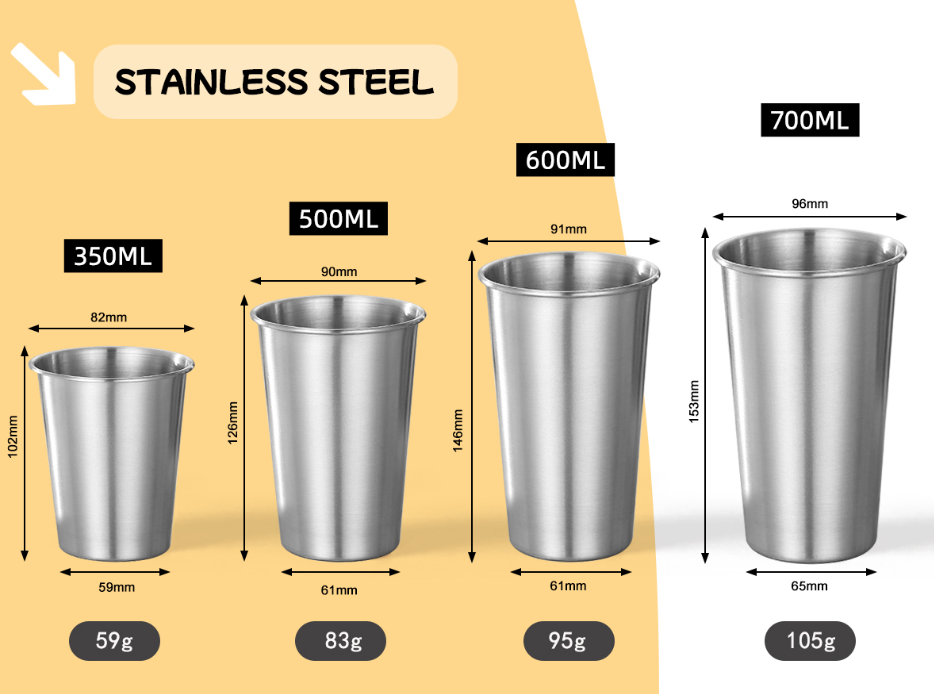
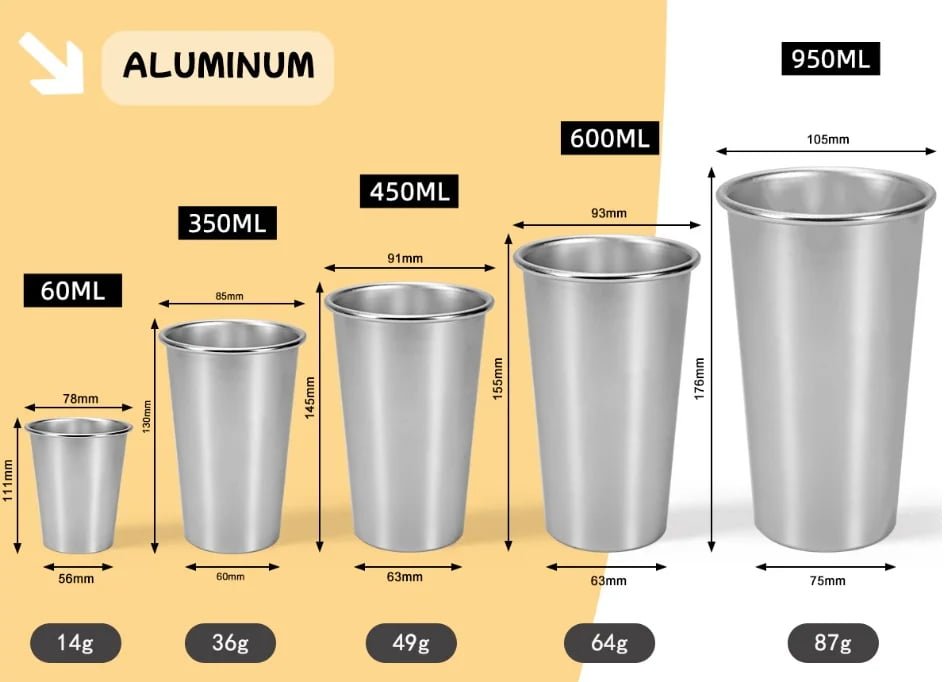
These are actual measurements from our product samples, not universal industry standards. Different cup structures and wall thicknesses will produce different results.
As you can see, our aluminum samples are approximately 33%–40% lighter than the corresponding stainless steel samples.
Why should you care about this?
Imagine you are developing cups for a music festival, a sports event, or an outdoor beverage brand. Your customers may need to carry these cups around for hours. A lighter product can make a real difference to their experience.
We generally recommend considering aluminum when your project focuses on:
- Lightweight drinkware.
- Outdoor activities and camping.
- Sports events and promotional campaigns.
- Large-volume merchandise distribution.
- Everyday cups that are easy to carry.
However, there is a trade-off. Aluminum is relatively soft, and thin-wall aluminum cups can be dented more easily.2
If you prefer a cup that feels heavier and more substantial in your hand, stainless steel may be a better choice.
Thermal Conductivity: Why Does Aluminum Feel Colder?
Here is something interesting about aluminum: it transfers heat much faster than stainless steel.3
Have you ever poured ice water into a metal cup and noticed how quickly the outside becomes cold?
That's exactly the experience aluminum can deliver.
Because of its excellent thermal conductivity, aluminum responds quickly to temperature changes. Stainless steel transfers heat more slowly, so the temperature response is generally less immediate.
Aluminum vs. Stainless Steel for Cold Drinks
| Feature | Aluminum | Stainless Steel |
|---|---|---|
| Thermal conductivity | Very high | Lower than aluminum |
| Cold-to-the-touch feeling | Fast and noticeable | Relatively slower |
| Temperature response | Fast | Relatively slower |
| Single-wall insulation | Poor | Poor |
| Vacuum insulation | Not typical for simple cups | Widely available |
One thing I always want buyers to understand is that high thermal conductivity does not mean better insulation.4
If you want your beverage to stay cold for several hours, a double-wall vacuum-insulated stainless steel tumbler is a much better option.5
But if you want your customers to enjoy the immediate sensation of a cold metal cup, aluminum is very interesting.
Why We Like Combining Aluminum with Color-Changing Technology
This is where things get even more interesting for us at Mugbaby.
We specialize in color-changing drinkware, and aluminum is a particularly attractive material for this application.
When you combine aluminum's excellent thermal conductivity with thermochromic printing, the cup can respond to temperature changes and create a visual surprise.6
Imagine pouring an iced drink into a colorful aluminum cup. As the temperature changes, the printed design changes color.
Your customers are no longer just drinking from a cup. They are interacting with the product.
This is why we believe aluminum color-changing cups have great potential for:
- Summer beverage promotions.
- Sports events.
- Music festivals.
- Brand marketing campaigns.
- Interactive promotional merchandise.
Of course, the actual color-changing speed also depends on the thermochromic pigment, activation temperature, printing thickness, cup structure, and beverage temperature.
Surface Finishes: Anodizing vs. Electrolytic Treatment
If you care about the appearance of your drinkware, this is one of the most important differences to understand.
Although both aluminum and stainless steel can achieve attractive metallic finishes, we use different surface treatment processes for these two materials.
Aluminum: The Beauty of Anodizing
One of the things I particularly like about aluminum cups is their anodized finish.
Anodizing creates an oxide layer on the aluminum surface. This layer can be dyed and sealed to produce different colors.7
What makes this process interesting is the way the color integrates with the surface.
Unlike conventional spray coating, which creates a separate coating on the surface, anodizing gives the aluminum a more unified appearance.8 It almost looks as if the material itself were naturally colored.
Depending on the processing method, we can also achieve consistent anodized finishes on accessible interior and exterior surfaces.
Think about the possibilities:
- Bright red.
- Vibrant green.
- Metallic blue.
- Purple.
- Gold.
- Silver.
- Other customized colors.
For brands targeting younger consumers, this is a great opportunity to create distinctive product collections.
Stainless Steel: A Different Kind of Metallic Finish
For the stainless steel cups in our comparison, we use a drawing process followed by electrolytic treatment.
The result is a more understated metallic appearance, with a relatively classic and restrained visual style.
I would describe the difference this way:
Aluminum gives you more opportunities to explore colorful metallic designs, while our electrolytically treated stainless steel cups offer a more understated and substantial appearance.
Of course, stainless steel can also be customized with different colors through PVD, spray coating, and other finishing processes.9
| Feature | Aluminum | Stainless Steel |
|---|---|---|
| Main process in our comparison | Anodizing | Drawing + electrolytic treatment |
| Typical appearance | Colorful metallic finish | Classic metallic finish |
| Color possibilities | Rich anodized colors | Depends on additional finishing |
| Surface treatment | Anodic oxide layer | Electrolytic treatment |
| Design direction | Colorful and youthful | Classic and understated |
When you develop your next collection, I suggest thinking about the feeling you want your product to communicate, not just the color you want to achieve.
Strength and Durability: Is Stainless Steel Really Better?
Yes, in many thin-wall cup designs, stainless steel offers better resistance to deformation.
This is one area where aluminum has a disadvantage.
Aluminum is relatively soft. If you squeeze or drop a thin aluminum cup, it may dent or deform more easily.
Stainless steel generally offers a stronger structure and a more substantial hand feel.
In our product demonstrations, we like to show customers the difference by applying pressure to the two cups. It is a simple way to help them understand how the materials behave.
What Should You Consider?
| Consideration | Aluminum | Stainless Steel |
|---|---|---|
| Resistance to deformation | More susceptible to dents | Generally higher |
| Hand pressure | Thin-wall cups may deform | Usually more resistant |
| Impact resistance | Requires careful handling | Generally better |
| Surface wear | Anodized layer can wear | Depends on finish and use |
| Long-term appearance | Requires appropriate care | Generally robust |
However, I don't want you to misunderstand one thing: stainless steel is not indestructible, and aluminum is not necessarily a disposable material.
The actual durability of a cup depends on its wall thickness, structure, manufacturing quality, and surface treatment.
Anodized aluminum also has its own durability considerations. Over time, friction, scratches, and unsuitable cleaning chemicals may affect the oxide layer and its appearance.
If your customers intend to use the cups frequently, I recommend testing actual samples under realistic conditions before placing a large order.
Design and Product Positioning: Which One Fits Your Brand?
Now let's talk about something beyond material properties: how your customers will perceive the product.
In our experience, aluminum and stainless steel often appeal to different product concepts.
Aluminum: Lightweight, Colorful, and More Casual
Aluminum is particularly interesting when you want your product to look fresh, colorful, and modern.
Its lightweight construction and anodized colors make it suitable for:
- Outdoor and camping drinkware.
- Summer beverage promotions.
- Sports merchandise.
- Music festivals.
- Colorful retail collections.
- Creative promotional products.
If your target audience is younger consumers, aluminum gives you plenty of room to experiment with color and design.
Stainless Steel: Substantial and More Classic
Stainless steel has a different personality.
Because it is generally heavier and more resistant to deformation, it can create a more substantial feeling in the hand.
If you are developing corporate gifts, commemorative products, or drinkware that needs a more traditional metallic appearance, stainless steel may be more appropriate.
It is also the more established choice when your product requires double-wall vacuum insulation.
Which Material Would I Recommend?
| Your Product Concept | My Recommendation |
|---|---|
| Lightweight outdoor cups | Aluminum |
| Colorful promotional cups | Aluminum |
| Color-changing cold drinkware | Aluminum is particularly interesting |
| Sports and event merchandise | Aluminum |
| Classic corporate gifts | Stainless Steel |
| Products with a substantial hand feel | Stainless Steel |
| Vacuum-insulated tumblers | Stainless Steel |
But remember, these are recommendations, not fixed rules. You can certainly develop colorful stainless steel products or lightweight stainless steel cups.
The final decision should always come back to your product concept and target customers.
Cost: Which Material Should You Choose for Your Budget?
This is usually one of the first questions customers ask us.
And honestly, I wouldn't tell you that aluminum is always cheaper than stainless steel, or the other way around.
The final price depends on much more than the material itself.
When we calculate the cost of a customized cup, we consider:
- Raw material price.
- Material thickness and weight.
- Forming and manufacturing processes.
- Surface treatment.
- Printing and decoration.
- Packaging.
- Order quantity.
For example, aluminum requires anodizing to achieve its characteristic colored finish, while stainless steel may require different forming and surface finishing processes.
A single-wall aluminum cup should also not be compared directly with a double-wall vacuum-insulated stainless steel tumbler.
My suggestion is simple: when you request quotations, make sure you are comparing products with similar capacities, structures, wall thicknesses, decoration requirements, and packaging.
That will give you a much more meaningful cost comparison.
Sustainability and Safety: What Should You Know?
Both aluminum and stainless steel are recyclable materials.10
Aluminum is particularly familiar to consumers because of its widespread use in beverage cans and beer packaging.
This familiarity can make aluminum cups an interesting choice for brands looking to communicate a connection with recyclable beverage packaging.
Stainless steel also has an established recycling value and is widely used in food-contact products.
But I want to make one point clear: recyclable does not automatically mean environmentally friendly in every situation.
The actual environmental impact depends on recycled content, manufacturing energy, transportation, product lifespan, and recycling infrastructure.11
What About Food-Contact Safety?
When you purchase aluminum drinkware, pay particular attention to the interior surface treatment or food-contact coating.12
For stainless steel, make sure the material grade is clearly specified and supported by appropriate documentation.
Here is what I recommend asking your supplier:
| Question | Why It Matters |
|---|---|
| What material is used? | Confirms material specifications |
| What surface treatment is applied? | Helps evaluate the finished surface |
| Is the interior suitable for food contact? | Important for beverage safety |
| Can you provide relevant test reports? | Supports compliance verification |
| How durable is the surface treatment? | Helps assess product lifespan |
At Mugbaby, we believe these questions should be discussed before production, not after a problem occurs.
So, Which One Should You Choose?
After looking at all these differences, I don't think there is one universal winner.
If you ask me which material I prefer, my answer would depend on the project.
If you are developing a lightweight, colorful cup for a summer promotion, I would seriously consider aluminum.
If you want a heavier, more substantial cup for a corporate gift collection, I would look at stainless steel.
If you want a color-changing cup that responds quickly to cold beverages, aluminum is particularly interesting.
And if you want a vacuum-insulated tumbler, stainless steel is the more practical choice.
Here is my final recommendation:
| If Your Priority Is... | I Would Choose... |
|---|---|
| Lightweight construction | Aluminum |
| Colorful anodized finishes | Aluminum |
| Fast thermal response | Aluminum |
| Color-changing cold drinkware | Aluminum |
| Better resistance to deformation | Stainless Steel |
| A more substantial hand feel | Stainless Steel |
| Double-wall vacuum insulation | Stainless Steel |
| Classic metallic gift products | Stainless Steel |
Our Advice: Start with Your Product, Not Just the Material
When customers come to us with a new drinkware idea, we don't always start by asking whether they prefer aluminum or stainless steel.
We first want to understand what they are trying to create.
Who will use the product? Where will it be used? What kind of experience do you want your customers to have? What is your target price?
Once we understand these questions, choosing the material becomes much easier.
At Mugbaby, we develop customized drinkware in aluminum, stainless steel, plastic, glass, and ceramic. We also specialize in color-changing drinkware and different printing and decoration technologies.
If you are still deciding between aluminum and stainless steel, feel free to contact us. Tell us about your project, and we can help you evaluate the materials, product structure, surface finishes, and customization possibilities.
We don't believe in choosing a material simply because it is popular. We believe in choosing the right material for the right product.
Frequently Asked Questions
Are aluminum cups lighter than stainless steel cups?
Yes. Aluminum has a much lower density than stainless steel. In our product samples, aluminum cups were approximately 33%–40% lighter than the corresponding stainless steel samples.
Do aluminum cups keep drinks colder than stainless steel cups?
Not necessarily. Aluminum transfers heat more quickly, so the cup wall responds faster to cold beverages. However, single-wall aluminum cups do not provide the insulation of double-wall vacuum-insulated stainless steel cups.
What is the difference between anodized aluminum and electrolytically treated stainless steel?
Anodizing creates an oxide layer on aluminum that can be dyed and sealed to achieve different colors. Our stainless steel comparison products use a drawing process followed by electrolytic treatment, producing a different metallic finish.
Can both aluminum and stainless steel cups change color?
Yes. Both materials can be developed with thermochromic decoration. Aluminum is particularly interesting because its high thermal conductivity helps transfer temperature changes quickly to the decorated surface.
Which material is better for promotional drinkware?
It depends on your campaign. Aluminum is attractive for lightweight, colorful, and interactive promotional products. Stainless steel is suitable for more substantial merchandise and premium gifts.
Is aluminum more environmentally friendly than stainless steel?
Not automatically. Both materials are recyclable. Their actual environmental impact depends on recycled content, manufacturing energy, product lifespan, and recycling infrastructure.
"Aluminium", https://en.wikipedia.org/wiki/Aluminium. Materials reference data report aluminum's density at roughly one-third that of common stainless steels, supporting the statement that aluminum drinkware can be lighter when geometry and wall thickness are comparable. Evidence role: general_support; source type: encyclopedia. Supports: Aluminum has a density of about 2.7 g/cm³, while common stainless steels are typically around 7.7–8.0 g/cm³.. Scope note: This supports the material-property explanation but does not verify the article's specific cup-weight measurements. ↩
"Material Overview • ANSI", https://www.purdue.edu/bidc/wp-content/uploads/2021/08/ISOGrade.pdf. Comparative materials-property data show that common aluminum alloys generally have lower hardness and yield-strength ranges than stainless steels used in consumer products, which is consistent with greater susceptibility to denting in thin-wall aluminum forms. Evidence role: mechanism; source type: research. Supports: Common aluminum alloys generally have lower hardness and strength values than common stainless steels, making thin sections more susceptible to plastic deformation under comparable loading.. Scope note: Actual denting depends on alloy, temper, wall thickness, geometry, and manufacturing quality, so the source would provide contextual support rather than a direct test of these cups. ↩
"Thermal Conductivity of the Elements", https://srd.nist.gov/jpcrdreprint/1.3253100.pdf. Standard materials data list aluminum with thermal conductivity near 200 W/m·K, while austenitic stainless steels are commonly around 15 W/m·K, supporting the statement that aluminum transfers heat much faster than stainless steel. Evidence role: mechanism; source type: research. Supports: Aluminum's thermal conductivity is far higher than that of stainless steel.. Scope note: Exact values vary by alloy, temperature, and processing condition. ↩
"Introduction to Engineering Heat Transfer", https://ocw.mit.edu/courses/16-050-thermal-energy-fall-2002/87d9f4544b7fd64a77201382500d057c_10_part3.pdf. Heat-transfer texts define thermal conductivity as a measure of a material's ability to conduct heat; high conductivity increases conductive heat flow rather than improving insulation. Evidence role: mechanism; source type: education. Supports: Thermal insulation relies on reducing heat transfer, and low thermal conductivity is typically associated with better insulation.. Scope note: This supports the physics principle, while the insulating performance of a finished cup also depends on wall structure, air gaps, lids, and convection. ↩
"Vacuum Flask", http://hyperphysics.phy-astr.gsu.edu/hbase/thermo/vacfla.html. Descriptions of vacuum flasks explain that a double-wall construction with an evacuated space reduces conduction and convection, supporting the claim that vacuum-insulated tumblers retain cold beverages more effectively than single-wall metal cups. Evidence role: mechanism; source type: encyclopedia. Supports: A vacuum layer between walls reduces conductive and convective heat transfer, explaining why vacuum-insulated vessels retain temperature better than single-wall metal containers.. Scope note: The source supports the insulation mechanism generally and may not compare every stainless-steel tumbler design or brand-specific performance. ↩
"Recent Advances in Reversible Thermochromic Materials for ...", https://pmc.ncbi.nlm.nih.gov/articles/PMC12942208/. Research on thermochromic pigments describes reversible or irreversible color changes triggered by temperature, supporting the article's explanation that temperature-responsive decoration can create visible effects on drinkware surfaces. Evidence role: mechanism; source type: paper. Supports: Thermochromic pigments or inks undergo visible color changes at specific temperature ranges, and substrate heat transfer can affect response behavior.. Scope note: The evidence supports the material mechanism but does not prove the response speed or durability of any specific printed cup design. ↩
"Anodizing.pdf", https://materialsdata.nist.gov/bitstream/handle/11115/221/Anodizing.pdf?sequence=1/1000. Surface-engineering references describe aluminum anodizing as an electrochemical process that forms a porous aluminum-oxide layer, which may be dyed and then sealed to create colored anodized finishes. Evidence role: definition; source type: education. Supports: Anodizing is an electrochemical process that thickens aluminum oxide on the surface, and porous anodic oxide can be dyed and sealed.. ↩
"Anodizing", https://en.wikipedia.org/wiki/Anodizing. Technical descriptions of anodizing note that the anodic oxide is grown from the aluminum surface, distinguishing it from applied organic coatings such as sprayed paint films. Evidence role: mechanism; source type: education. Supports: Anodizing forms an oxide layer from the aluminum substrate, whereas spray coatings generally deposit a separate coating layer on top of a surface.. Scope note: This supports the process distinction; the judgment that the finish looks more unified is partly aesthetic and depends on process quality. ↩
"PVD for Decorative Applications: A Review - PMC - NIH", https://pmc.ncbi.nlm.nih.gov/articles/PMC10381906/. Research on decorative and functional stainless-steel coatings describes physical vapor deposition and applied coating systems as methods for producing colored or modified stainless-steel surfaces. Evidence role: general_support; source type: paper. Supports: PVD and coating technologies can be used to alter the appearance and color of stainless-steel surfaces.. Scope note: The source would support the feasibility of these finishing routes, not the suitability, cost, or durability of any particular drinkware finish. ↩
"Aluminum: Material-Specific Data", https://www.epa.gov/facts-and-figures-about-materials-waste-and-recycling/aluminum-material-specific-data. Institutional materials-recycling sources identify aluminum and steel as recyclable metals, supporting the article's statement that both aluminum and stainless-steel drinkware are made from recyclable materials. Evidence role: general_support; source type: institution. Supports: Aluminum and steel, including stainless steel, are recyclable metal materials.. Scope note: Recyclability does not guarantee that a specific cup will be collected, sorted, accepted, or recycled in a given local waste system. ↩
"in packaging for - food & beverage applications", https://sustainable.columbia.edu/sites/default/files/content/Documents/food_packaging_4.11.13_HQ.pdf. Life-cycle assessment literature evaluates reusable products across raw-material extraction, manufacturing energy, transport, use phase, product lifetime, recycled content, and end-of-life treatment, supporting the article's caution that recyclability alone does not determine environmental performance. Evidence role: general_support; source type: paper. Supports: Life-cycle impacts of reusable products depend on production inputs, transport, use duration, recycled content, and end-of-life management.. Scope note: The evidence is contextual unless the cited study specifically analyzes aluminum and stainless-steel cups with the same assumptions. ↩
"FDA Issues Warning About Imported Cookware That May ...", https://www.fda.gov/food/alerts-advisories-safety-information/fda-issues-warning-about-imported-cookware-may-leach-lead-august-2025. Government food-contact guidance treats metals and coatings as materials that must be suitable for their intended food-contact conditions, supporting the article's advice to verify the interior treatment of aluminum drinkware. Evidence role: expert_consensus; source type: government. Supports: Food-contact materials must be suitable for intended use, and aluminum contact surfaces or coatings may require evaluation for migration and compliance.. Scope note: This supports the need for compliance review but does not determine whether any specific aluminum cup or coating is safe. ↩